Farm Facts
- Farm in south Northumberland in partnership with my father.
- Owner-occupied, FBTs, CFA agreements and short-term grazing.
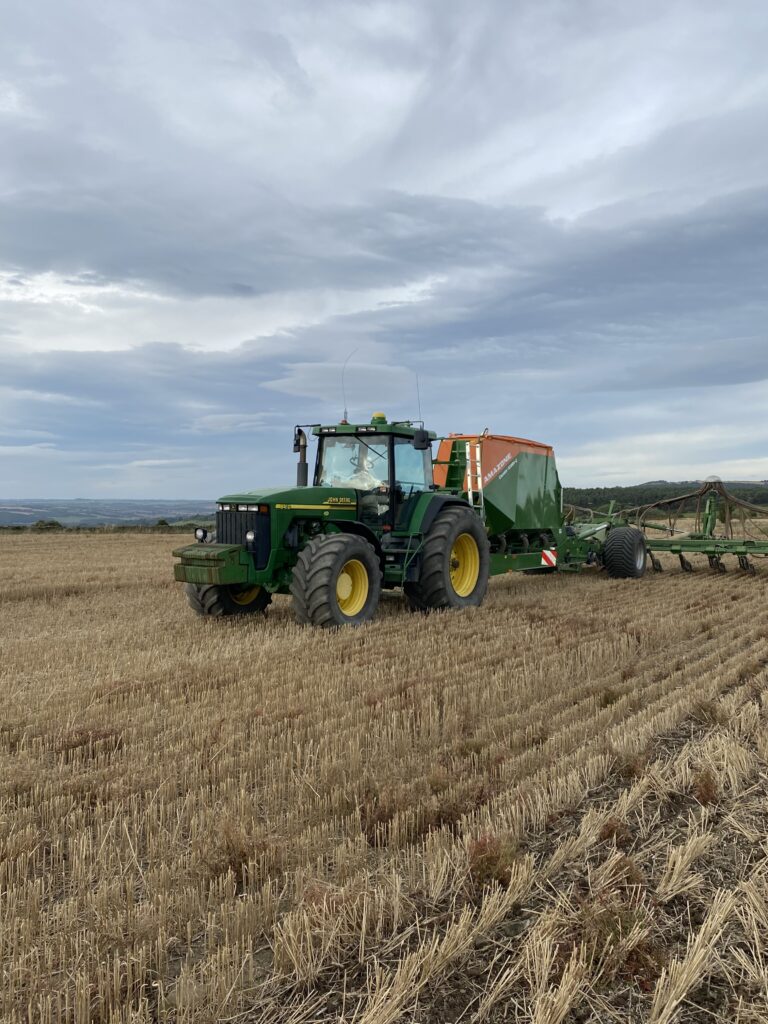
- 800 hectares of arable with rotation of wheat, OSR and legume fallow.
- Reduced tillage since 1998 and 99% no-till since 2012, with some areas not having been inverted for 26 years.
- 170 suckler cows and followers, all grass fed.
- We are in a Countryside Stewardship agreement, SFI and also have an SSSI on the farm.
- Grain drying and storage up to 16,000 tonnes, and a small haulage fleet working with local farmers and merchants.
What a Load of Bollocks
It’s been a long time since I have had time to put a few words together for Direct Driller, and a lot has happened. Oh boy, has it. A change of government (hence the title of this article) and a numpty of a prime minister who has not lasted two years but has managed to create a catalogue of problems and disasters – for the farmers, landowners and, in fact, all businesses – which we are all too familiar with.
And then what happens? You could not make it up! (WHAT A LOAD OF BOLLOCKS) We seem to have been blessed with the King of the North, and that is just a whole load of…in fact, a truckload of…! Andy who?! A bloke that has just dropped out of the sky, unelected. I mean, what a load of…!
But it will all be alright because we now have a 25-year roadmap for farming. (I am not going to say it!) Yet there seems to be no clarity with the 2026 SFI or a true direction. With a lot more questions than answers, it’s like a perfect storm. Especially as Trump is involved, and we all know the consequences and implications of that.
Enough of all that. (Rant over!) Let’s talk about BASE-UK. For those who don’t know, I have the privilege of being chairman of this farmer-led knowledge exchange organisation, with its main focus on Conservation Agriculture (regen ag). We have a strong membership from all over the country, from the top of Scotland to the south of England, which creates a fantastic community and a wealth of knowledge and experience from farmers and other experts within the industry. We have a great committee that keeps things moving forward, and their energy, commitment and enthusiasm for the organisation is second to none. We have had a busy few months since the turn of the year. Our two-day conference in Huntingdon showcased the great amount of passion and positivity for agriculture and BASE, with members speaking about some of the fantastic things they are doing on their farms. It’s a must for the coming February for those wanting to connect and learn more about regen and BASE.
We also headed to Cereals at Diddly Squat once again to host the regen programme. I felt it was a huge success in promoting BASE and regen, with some great conversations and debate, despite the weather. A big thank you to all those involved.
And then Groundswell for yet another great two days. It was good to catch up with both members and friends, and the weather was definitely an improvement on Cereals! The run-up to Groundswell was also busy, as we welcomed some New Zealanders with an appetite to learn more about what we are doing here in the UK. It was great to meet Findal, Samantha and Aimee as they travelled from Scotland down the country visiting BASE members and research centres, finishing their trip at Groundswell. I must say a huge thank you to all members and others involved who gave up their time and opened up their farms to facilitate this. Sharing knowledge, ideas and real-life experiences from around the world is what BASE is all about. You cannot buy that; knowledge is priceless. Again, thanks to all involved.
So, back to the farm and not really sure what to say. When I think back (we have been on this CA journey now for more than 20 years), and I seem to think I have cracked it, I soon realise how little I know compared to others pushing the boundaries within CA. But what I do know is that the farm generally looks well. We are in our final year of the 2023 SFI, which has allowed us to reduce risk with the use of rotational legume fallow. So, the rotation at present is 50 per cent first wheat, OSR and legume fallow, with the focus on building our soil health and resilience in the growing crop; something we have definitely seen over the last couple of years. (Unfortunately, that is all going to change; it’s just all too short term.) The wheats have stood up well to the dry conditions, and I am convinced this has been helped by focusing on soil health with the cover crop and no-till system over the years.
I make sure that we feed the crop early in the year, building biomass through high seed rates at drilling and early high rates of nitrogen. I have tried reducing nitrogen over the years, and generally this has a detrimental effect on the crops’ performance. I need consistency and reliability year-on-year, but of course the weather has the final say!
Going forward, we will have to create the best plan we can with the SFI, again with the focus on consistency of the growing crop and to continue to build soil health. After all, it’s not rocket science: healthy soil equals healthy plants, a more consistent yield and possibly an increase, along with all the nutritional benefits down the food chain. I am convinced that our soils could solve a lot of our problems, yet most around the world seem to neglect them instead.
Where growing crops is marginal at best, cattle are doing a little better, with a steady number of 170 suckler cows plus followers. But again, nothing is straightforward, so from mob grazing and moving cattle daily, we have moved back to a set-stocked system (which we need to work on). We did see grass growth improvements, but unfortunately, with not being ring-fenced and the lack of infrastructure (mainly water and fencing, along with short-term tenancies and grazing licences), we couldn’t maintain it. However, our Belted Galloway and Angus crosses are fed with a focus on the quality of the end product.
A lot of you will have already started harvest. We are still two-and-a-half weeks away, with only OSR and wheat, yet it’s still going to be relatively early by the looks of things. As always, I’m looking forward to it, and hopefully will have some biggish covers to drill into – by early September, with any luck.
Let’s hope the world and the UK come to their senses! (Yet I am not holding my breath.) I do hope we all have a good harvest and a successful autumn.