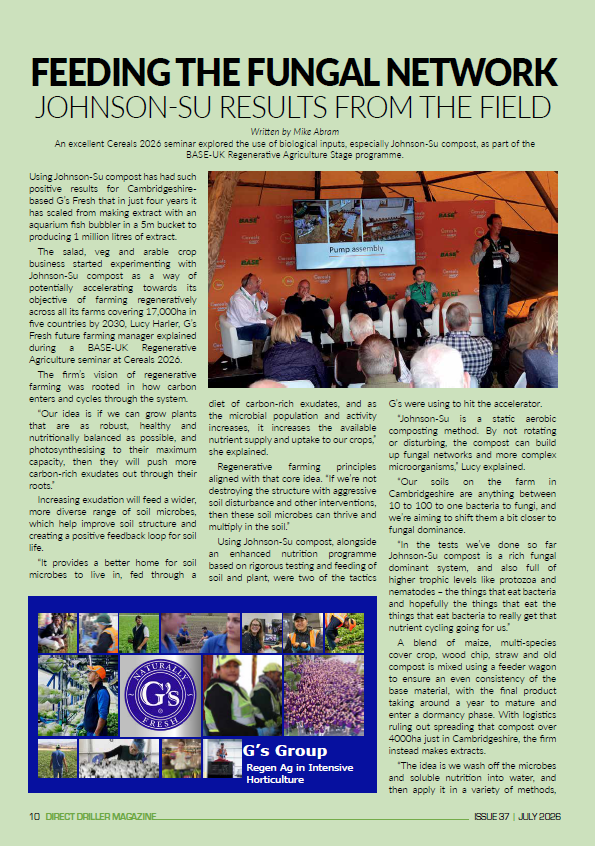
An excellent Cereals 2026 seminar explored the use of biological inputs, especially Johnson-Su compost, as part of the BASE-UK Regenerative Agriculture Stage programme.
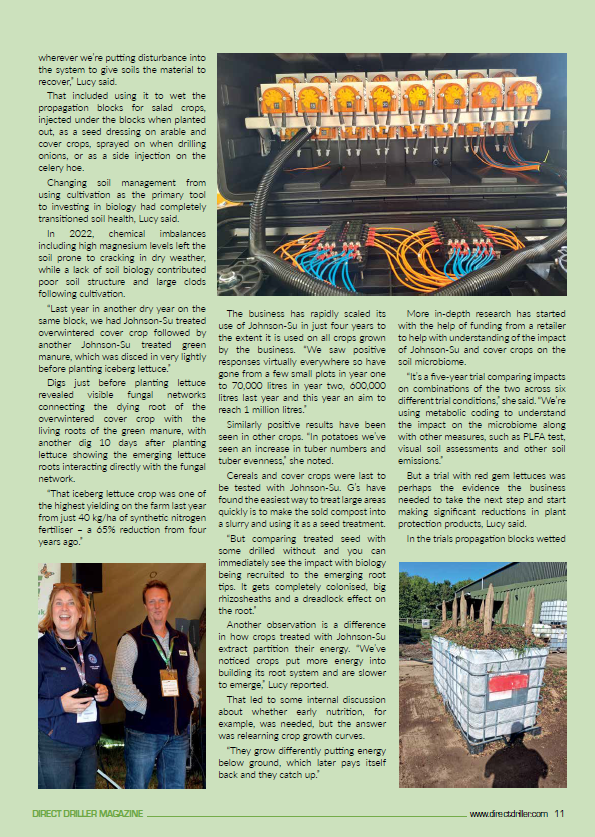
Using Johnson-Su compost has had such positive results for Cambridgeshire-based G’s Fresh that in just four years it has scaled from making extract with an aquarium fish bubbler in a 5m bucket to producing 1 million litres of extract.
The salad, veg and arable crop business started experimenting with Johnson-Su compost as a way of potentially accelerating towards its objective of farming regeneratively across all its farms covering 17,000ha in five countries by 2030, Lucy Harler, G’s Fresh future farming manager explained during a BASE-UK Regenerative Agriculture seminar at Cereals 2026.
The firm’s vision of regenerative farming was rooted in how carbon enters and cycles through the system. “Our idea is if we can grow plants that are as robust, healthy and nutritionally balanced as possible, and photosynthesising to their maximum capacity, then they will push more carbon-rich exudates out through their roots.”
Increasing exudation will feed a wider, more diverse range of soil microbes, which help improve soil structure and creating a positive feedback loop for soil life.
“It provides a better home for soil microbes to live in, fed through a diet of carbon-rich exudates, and as the microbial population and activity increases, it increases the available nutrient supply and uptake to our crops,” she explained.
Regenerative farming principles aligned with that core idea. “If we’re not destroying the structure with aggressive soil disturbance and other interventions, then these soil microbes can thrive and multiply in the soil.”
Using Johnson-Su compost, alongside an enhanced nutrition programme based on rigorous testing and feeding of soil and plant, were two of the tactics G’s were using to hit the accelerator.
“Johnson-Su is a static aerobic composting method. By not rotating or disturbing, the compost can build up fungal networks and more complex microorganisms,” Lucy explained.
“Our soils on the farm in Cambridgeshire are anything between 10 to 100 to one bacteria to fungi, and we’re aiming to shift them a bit closer to fungal dominance.
“In the tests we’ve done so far Johnson-Su compost is a rich fungal dominant system, and also full of higher trophic levels like protozoa and nematodes – the things that eat bacteria and hopefully the things that eat the things that eat bacteria to really get that nutrient cycling going for us.”

A blend of maize, multi-species cover crop, wood chip, straw and old compost is mixed using a feeder wagon to ensure an even consistency of the base material, with the final product taking around a year to mature and enter a dormancy phase. With logistics ruling out spreading that compost over 4000ha just in Cambridgeshire, the firm instead makes extracts.
“The idea is we wash off the microbes and soluble nutrition into water, and then apply it in a variety of methods, wherever we’re putting disturbance into the system to give soils the material to recover,” Lucy said.
That included using it to wet the propagation blocks for salad crops, injected under the blocks when planted out, as a seed dressing on arable and cover crops, sprayed on when drilling onions, or as a side injection on the celery hoe.
Changing soil management from using cultivation as the primary tool to investing in biology had completely transitioned soil health, Lucy said.
In 2022, chemical imbalances including high magnesium levels left the soil prone to cracking in dry weather, while a lack of soil biology contributed poor soil structure and large clods following cultivation.

“Last year in another dry year on the same block, we had Johnson-Su treated overwintered cover crop followed by another Johnson-Su treated green manure, which was disced in very lightly before planting iceberg lettuce.”
Digs just before planting lettuce revealed visible fungal networks connecting the dying root of the overwintered cover crop with the living roots of the green manure, with another dig 10 days after planting lettuce showing the emerging lettuce roots interacting directly with the fungal network.
“That iceberg lettuce crop was one of the highest yielding on the farm last year from just 40 kg/ha of synthetic nitrogen fertiliser – a 65% reduction from four years ago.”
The business has rapidly scaled its use of Johnson-Su in just four years to the extent it is used on all crops grown by the business. “We saw positive responses virtually everywhere so have gone from a few small plots in year one to 70,000 litres in year two, 600,000 litres last year and this year an aim to reach 1 million litres.”
Similarly positive results have been seen in other crops. “In potatoes we’ve seen an increase in tuber numbers and tuber evenness,” she noted.
Cereals and cover crops were last to be tested with Johnson-Su. G’s have found the easiest way to treat large areas quickly is to make the sold compost into a slurry and using it as a seed treatment.
“But comparing treated seed with some drilled without and you can immediately see the impact with biology being recruited to the emerging root tips. It gets completely colonised, big rhizosheaths and a dreadlock effect on the root.”
Another observation is a difference in how crops treated with Johnson-Su extract partition their energy. “We’ve noticed crops put more energy into building its root system and are slower to emerge,” Lucy reported.
That led to some internal discussion about whether early nutrition, for example, was needed, but the answer was relearning crop growth curves. “They grow differently putting energy below ground, which later pays itself back and they catch up.”
More in-depth research has started with the help of funding from a retailer to help with understanding of the impact of Johnson-Su and cover crops on the soil microbiome.
“It’s a five-year trial comparing impacts on combinations of the two across six different trial conditions,” she said. “We’re using metabolic coding to understand the impact on the microbiome along with other measures, such as PLFA test, visual soil assessments and other soil emissions.”
But a trial with red gem lettuces was perhaps the evidence the business needed to take the next step and start making significant reductions in plant protection products, Lucy said.
In the trials propagation blocks wetted with Johnson-Su extract showed better head fill, uniformity and packet quality, with treated plants more vibrant with deeper red colour and shinier leaves – something Lucy attributes to higher levels of plant health.

“If you’re familiar with John Kempf’s plant health pyramid idea – we can see if we have got nutrition right pretty easily in our sap test results, but evidencing the higher levels of plant health, lipid synthesis and secondary metabolites is quite difficult.
“But that’s what we think the difference was between these lettuces as the only change was that we wetted some of the blocks in Johnson-Su extract.
“Showing that we have really healthy, vibrant plants that are reaching those higher levels on the plant health pyramid and becoming resistant to fungal pathogens is exactly what we need to continue progressing and change the current feeling that the risk of reducing insecticide and fungicide programmes is a little bit greater than the reward,” she concluded.
G’s experience inspires Northants farm
When a forward-thinking business such as G’s Fresh fully embraces a new and sometimes controversial technology like Johnson-Su composting, it can be enough to encourage others to test in on farm.
That’s exactly what happened at FRW Farrington & Son, home to the Mellow Yellow range of cold-pressed rapeseed oil products, based at Hargrave in Northamptonshire.
Despite a very keen eye on sustainability – Farrington’s Mellow Yellow Rapeseed oil was the world’s first food product to be certified as both carbon and plastic neutral – the farm had sat on the fence about using compost until farm owner Duncan Farrington visited G’s, explained farm manager Stuart Tabernor.
“He came back and told me we’re doing compost. I’ve seen it working and I want you to go down that route,” he said.
The only problem, although maybe not surprising, was the budget was basically zero.
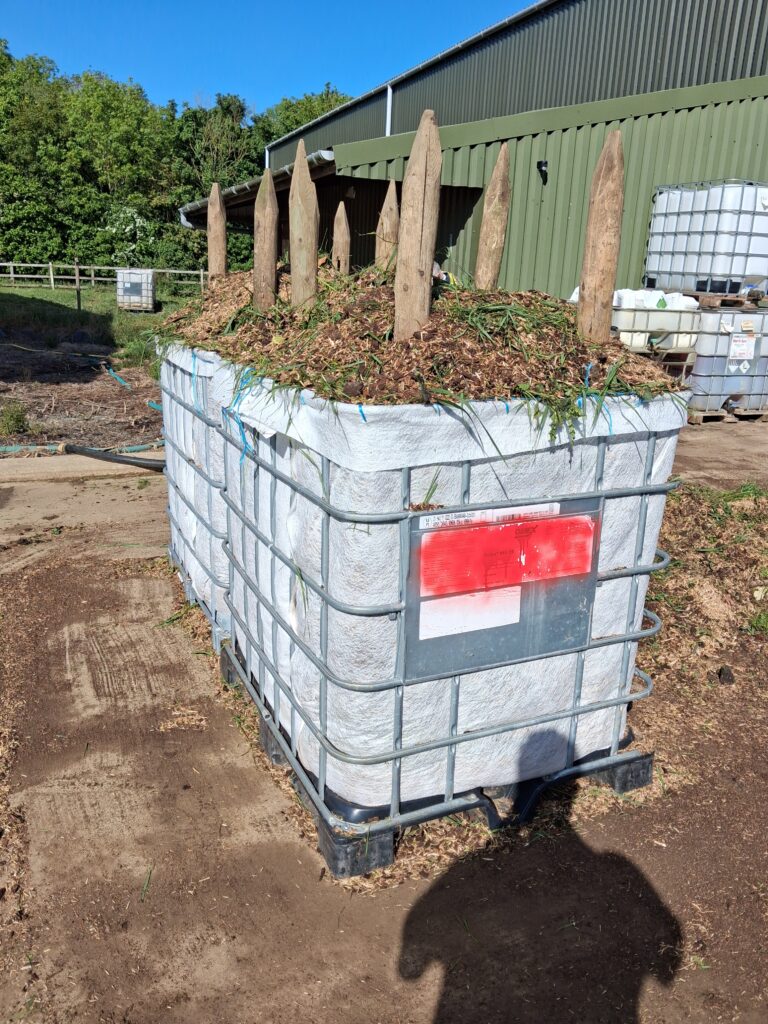
But, according to Stuart, it doesn’t need to be an expensive pursuit. He’s made his first batch of four IBCs of Johnson-Su from cover crop material, wood chip and tailings from the cold press oil factory.
“It took us about half a day to make the tanks from scratch and half a day to mix the compost using a tractor and loader, and put the posts in. Next time I’m using the mini-digger – I can’t justify buying a feed mixer wagon for a few IBCs of compost.”
Like G’s, Stuart is planning to apply an extract, initially with the seed at drilling. Applying it as a seed dressing before drilling was initially considered but the challenge was that the farm wasn’t set up to do that and asking a mobile seed treater to do it was unlikely to be met with a favourable response.
“With mobile seed treaters predominantly applying fungicides to the grain, there is also a risk that the fungal strands are killed as they pass through,” he noted.
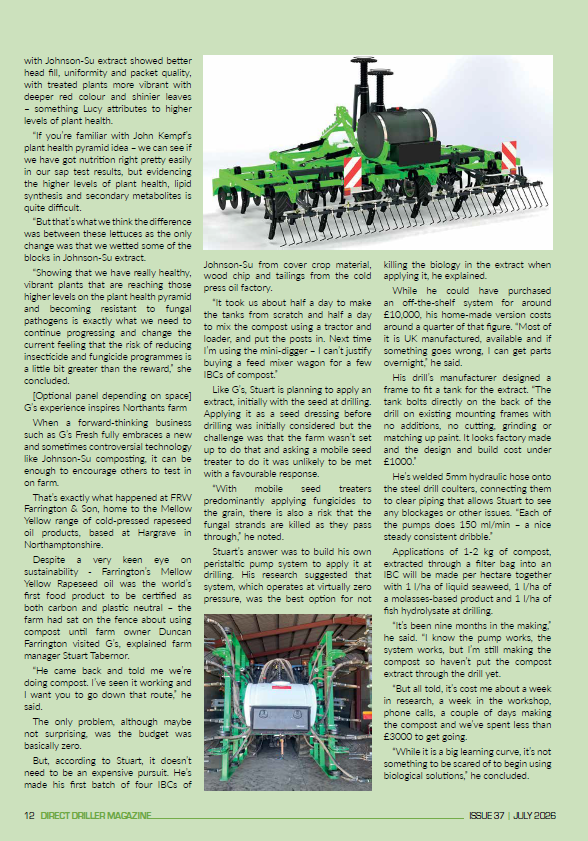
Stuart’s answer was to build his own peristaltic pump system to apply it at drilling. His research suggested that system, which operates at virtually zero pressure, was the best option for not killing the biology in the extract when applying it, he explained.
While he could have purchased an off-the-shelf system for around £10,000, his home-made version costs around a quarter of that figure. “Most of it is UK manufactured, available and if something goes wrong, I can get parts overnight,” he said.
His drill’s manufacturer designed a frame to fit a tank for the extract. “The tank bolts directly on the back of the drill on existing mounting frames with no additions, no cutting, grinding or matching up paint. It looks factory made and the design and build cost under £1000.”
He’s welded 5mm hydraulic hose onto the steel drill coulters, connecting them to clear piping that allows Stuart to see any blockages or other issues. “Each of the pumps does 150 ml/min – a nice steady consistent dribble.”
Applications of 1-2 kg of compost, extracted through a filter bag into an IBC will be made per hectare together with 1 l/ha of liquid seaweed, 1 l/ha of a molasses-based product and 1 l/ha of fish hydrolysate at drilling.
“It’s been nine months in the making,” he said. “I know the pump works, the system works, but I’m still making the compost so haven’t put the compost extract through the drill yet.
“But all told, it’s cost me about a week in research, a week in the workshop, phone calls, a couple of days making the compost and we’ve spent less than £3000 to get going.
“While it is a big learning curve, it’s not something to be scared of to begin using biological solutions,” he concluded.