Following its arrival on the 2024 Recommended List (RL) just two and a half years ago, Group 3 soft wheat Bamford became the UK’s market-leading winter wheat for the 2025/2026 season – the first Group 3 variety to achieve that number one position since Robigus in 2005. However, with just two commercial seasons under its belt, ever-rising popularity among growers and strong seed industry support, could Bamford’s best years still lie ahead, suggests Hutchinsons’ National Seed Manager David Bouch.
David says: “With three end markets and a yield still rivalling the best hard Group 4 feed wheats, it’s not hard to understand why Bamford has been on a continuous upward curve. An overall market share of just over 14% of C2 seed sales for 2025, achieved against a very competitive line-up of other varieties, was remarkable, particularly when you consider the total percentage of Group 3 seed sales for harvest 2024 was just 1.6%.
“For any variety to become a market leader, it has to perform consistently well from day one, and Bamford has done that since I first observed it in 2022 trials. Even last season, when we saw the impact of the breakdown in yellow rust resistance, it was interesting to note that Bamford was judged as being safer than many other popular varieties.
“So, have we seen the best of Bamford yet in term of its yield performances? Based on a broad assessment of the last three seasons, during which we’ve had two extremely dry years and one year when it never seemed to stop raining, I’m tempted to say no. Hopefully, 2026 will finally deliver better growing conditions for all our farmers across all regions and prove me right.
“Whatever happens weather-wise in the run-up to harvest, it’s important for growers to remember that Bamford has already proved itself on different soil types and in differing conditions across all regions. On treated yield, it competes favourably against other popular Group 4 feed varieties, such as KWS Scope, Champion and LG Beowulf and, importantly, it possesses both a higher untreated yield and has far superior end market potential than all of them.
“Whether it will retain its number one position for crop27 is difficult to say (given the competitive nature of the RL and arrival of other newer varieties), however I can certainly see it remaining as the dominant Group 3 variety and, for me, it still sets the benchmark as the UK’s current leading soft wheat,” he concludes.
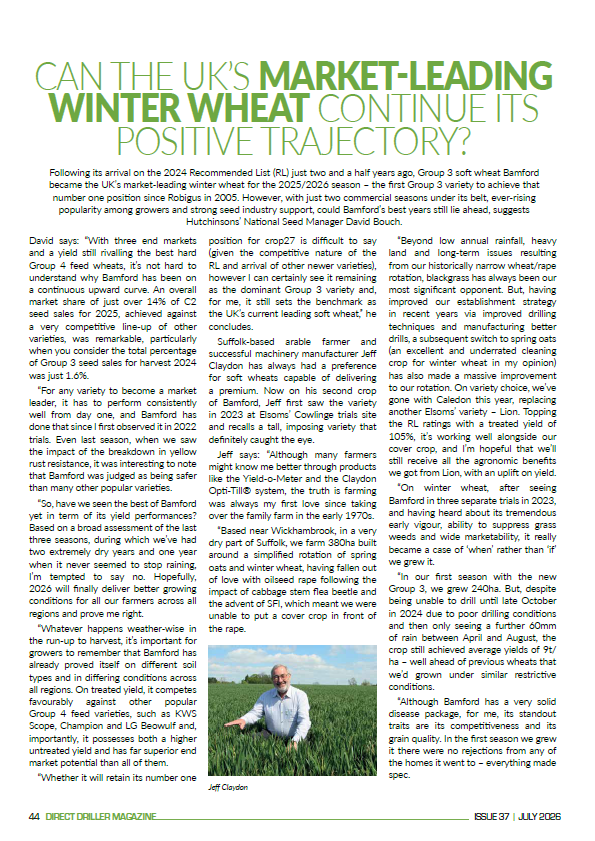
Suffolk-based arable farmer and successful machinery manufacturer Jeff Claydon has always had a preference for soft wheats capable of delivering a premium. Now on his second crop of Bamford, Jeff first saw the variety in 2023 at Elsoms’ Cowlinge trials site and recalls a tall, imposing variety that definitely caught the eye.
Jeff says: “Although many farmers might know me better through products like the Yield-o-Meter and the Claydon Opti-Till® system, the truth is farming was always my first love since taking over the family farm in the early 1970s.
“Based near Wickhambrook, in a very dry part of Suffolk, we farm 380ha built around a simplified rotation of spring oats and winter wheat, having fallen out of love with oilseed rape following the impact of cabbage stem flea beetle and the advent of SFI, which meant we were unable to put a cover crop in front of the rape.
“Beyond low annual rainfall, heavy land and long-term issues resulting from our historically narrow wheat/rape rotation, blackgrass has always been our most significant opponent. But, having improved our establishment strategy in recent years via improved drilling techniques and manufacturing better drills, a subsequent switch to spring oats (an excellent and underrated cleaning crop for winter wheat in my opinion) has also made a massive improvement to our rotation. On variety choice, we’ve gone with Caledon this year, replacing another Elsoms’ variety – Lion. Topping the RL ratings with a treated yield of 105%, it’s working well alongside our cover crop, and I’m hopeful that we’ll still receive all the agronomic benefits we got from Lion, with an uplift on yield.
“On winter wheat, after seeing Bamford in three separate trials in 2023, and having heard about its tremendous early vigour, ability to suppress grass weeds and wide marketability, it really became a case of ‘when’ rather than ‘if’ we grew it.
“In our first season with the new Group 3, we grew 240ha. But, despite being unable to drill until late October in 2024 due to poor drilling conditions and then only seeing a further 60mm of rain between April and August, the crop still achieved average yields of 9t/ha – well ahead of previous wheats that we’d grown under similar restrictive conditions.
“Although Bamford has a very solid disease package, for me, its standout traits are its competitiveness and its grain quality. In the first season we grew it there were no rejections from any of the homes it went to – everything made spec.
“Our current crop looks strong and exceptionally clean following some inter-row hoeing to improve our weed management systems. We’ve always used a 4-spray fungicide programme – applying both a T0 and T1, with a ‘safety-first’ approach to controlling both rust and, more importantly, Septoria, which I see as a greater threat to yield potential.
“On yield potential, I tend to agree with David in that I don’t really think we’ve seen the best of Bamford yet. Hopefully, this season we’ll receive a bit more rain and achieve the 11-12t/ha yield that I believe the variety fully merits,” adds Jeff.
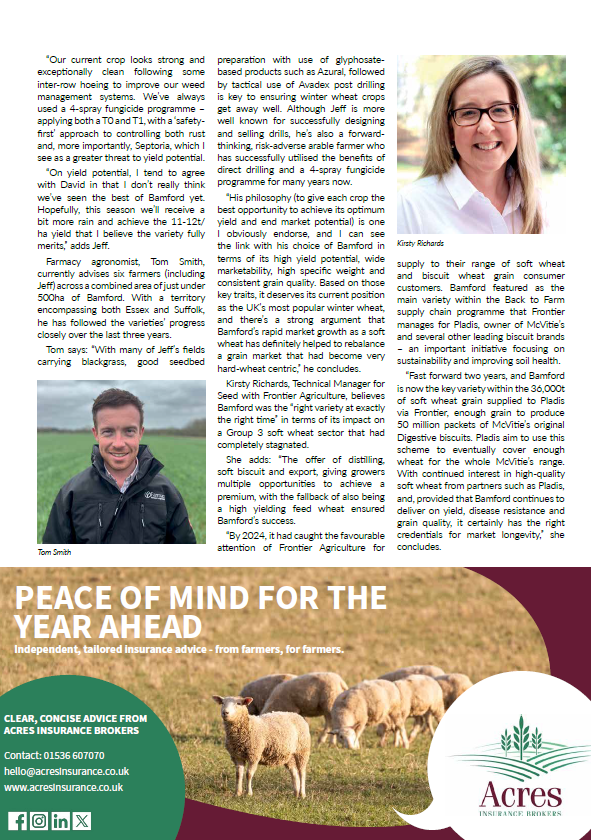
Farmacy agronomist, Tom Smith, currently advises six farmers (including Jeff) across a combined area of just under 500ha of Bamford. With a territory encompassing both Essex and Suffolk, he has followed the varieties’ progress closely over the last three years.


Tom says: “With many of Jeff’s fields carrying blackgrass, good seedbed preparation with use of glyphosate-based products such as Azural, followed by tactical use of Avadex post drilling is key to ensuring winter wheat crops get away well. Although Jeff is more well known for successfully designing and selling drills, he’s also a forward-thinking, risk-adverse arable farmer who has successfully utilised the benefits of direct drilling and a 4-spray fungicide programme for many years now.
“His philosophy (to give each crop the best opportunity to achieve its optimum yield and end market potential) is one I obviously endorse, and I can see the link with his choice of Bamford in terms of its high yield potential, wide marketability, high specific weight and consistent grain quality. Based on those key traits, it deserves its current position as the UK’s most popular winter wheat, and there’s a strong argument that Bamford’s rapid market growth as a soft wheat has definitely helped to rebalance a grain market that had become very hard-wheat centric,” he concludes.
Kirsty Richards, Technical Manager for Seed with Frontier Agriculture, believes Bamford was the “right variety at exactly the right time” in terms of its impact on a Group 3 soft wheat sector that had completely stagnated.
She adds: “The offer of distilling, soft biscuit and export, giving growers multiple opportunities to achieve a premium, with the fallback of also being a high yielding feed wheat ensured Bamford’s success.
“By 2024, it had caught the favourable attention of Frontier Agriculture for supply to their range of soft wheat and biscuit wheat grain consumer customers. Bamford featured as the main variety within the Back to Farm supply chain programme that Frontier manages for Pladis, owner of McVitie’s and several other leading biscuit brands – an important initiative focusing on sustainability and improving soil health.
“Fast forward two years, and Bamford is now the key variety within the 36,000t of soft wheat grain supplied to Pladis via Frontier, enough grain to produce 50 million packets of McVitie’s original Digestive biscuits. Pladis aim to use this scheme to eventually cover enough wheat for the whole McVitie’s range. With continued interest in high-quality soft wheat from partners such as Pladis, and, provided that Bamford continues to deliver on yield, disease resistance and grain quality, it certainly has the right credentials for market longevity,” she concludes.