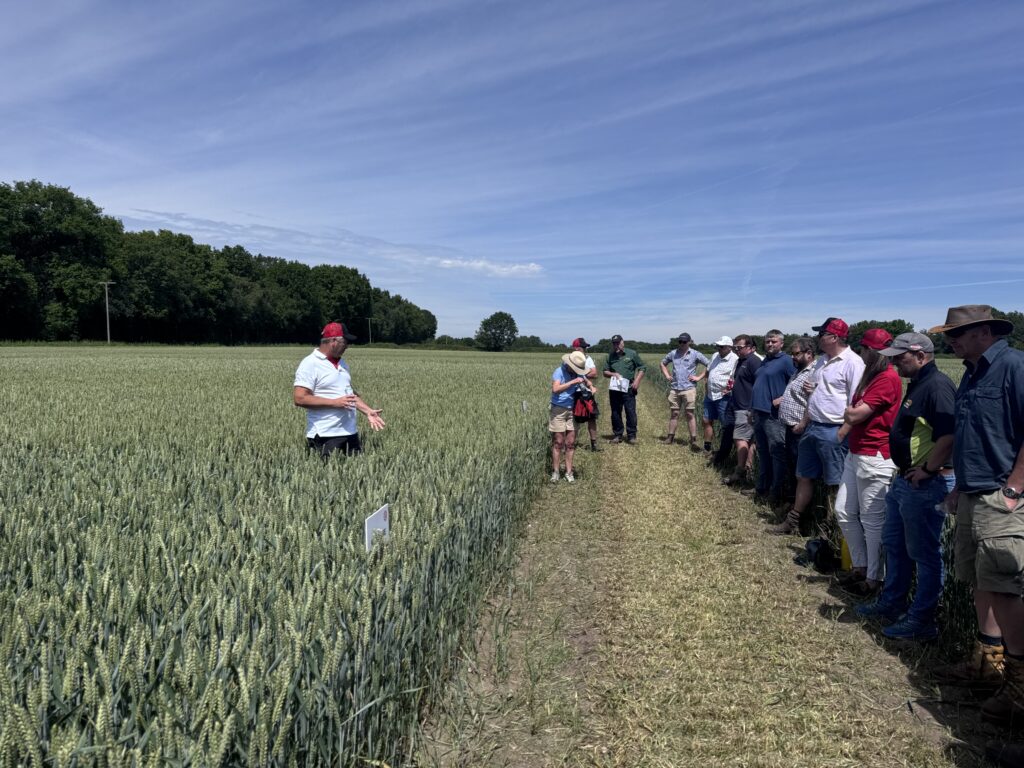
This is the first of a four-part series examining how the UK’s variety selection system is responding to a changing agricultural landscape. Over the course of three summer demonstration days, hosted by Limagrain in Staffordshire, Agrovista at their Lamport AgX site in Northamptonshire, and Bayer in Oxfordshire, a consistent set of questions emerged about the AHDB Recommended Lists (RL): whether they are keeping pace with the shift towards lower-input farming and what is already being done to address this. The series concludes with a look at the research and policy changes that suggest the RL is beginning to evolve. The picture that emerges is not one of a broken system,
but of an industry in transition, and a variety selection framework that is being challenged to keep up.
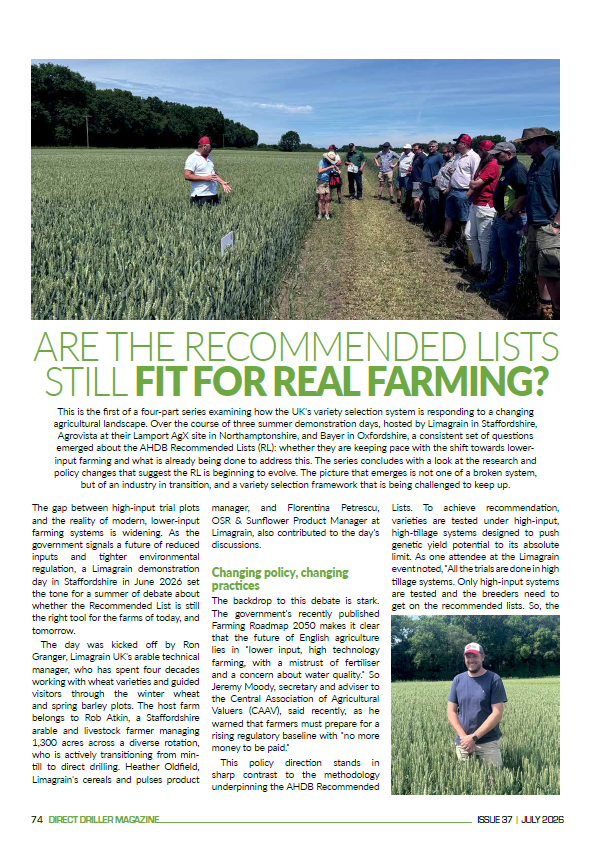
The gap between high-input trial plots and the reality of modern, lower-input farming systems is widening. As the government signals a future of reduced inputs and tighter environmental regulation, a Limagrain demonstration day in Staffordshire in June 2026 set the tone for a summer of debate about whether the Recommended List is still the right tool for the farms of today, and tomorrow.
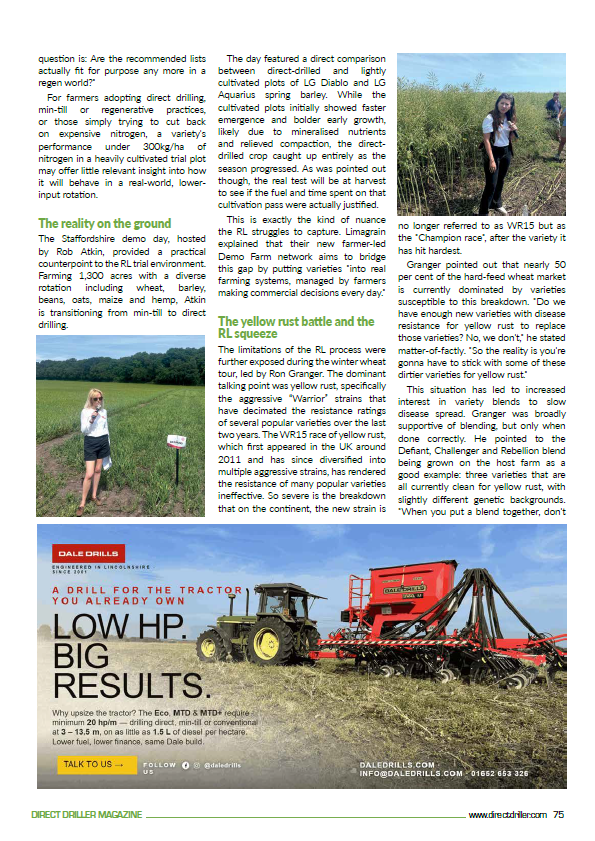
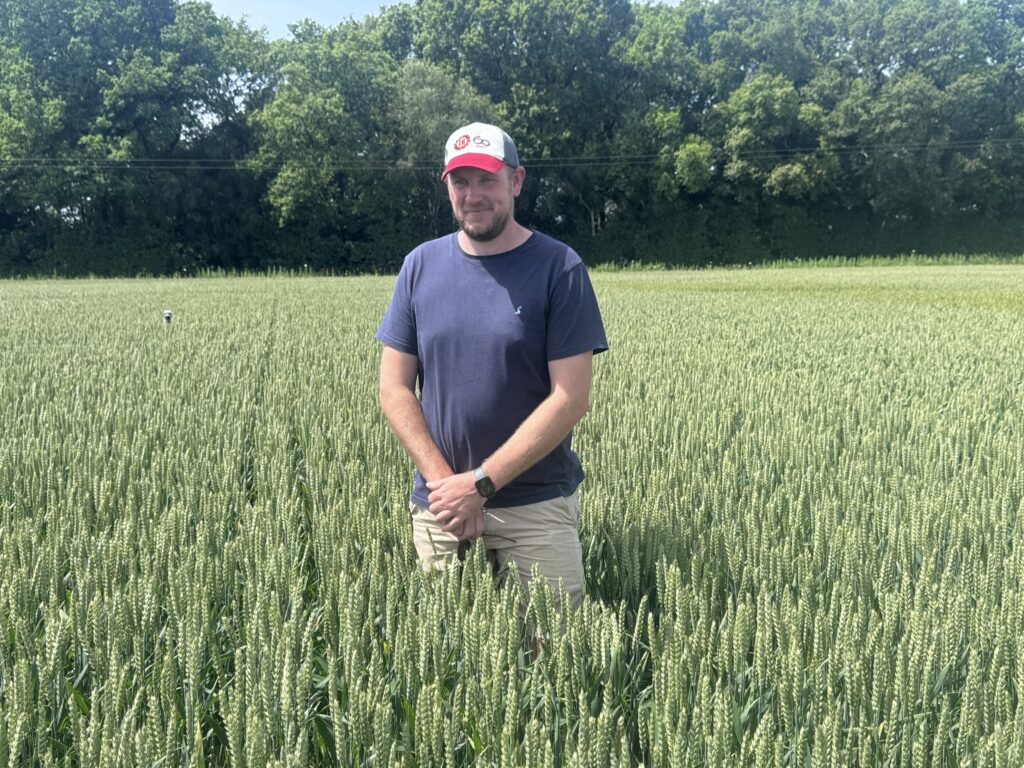
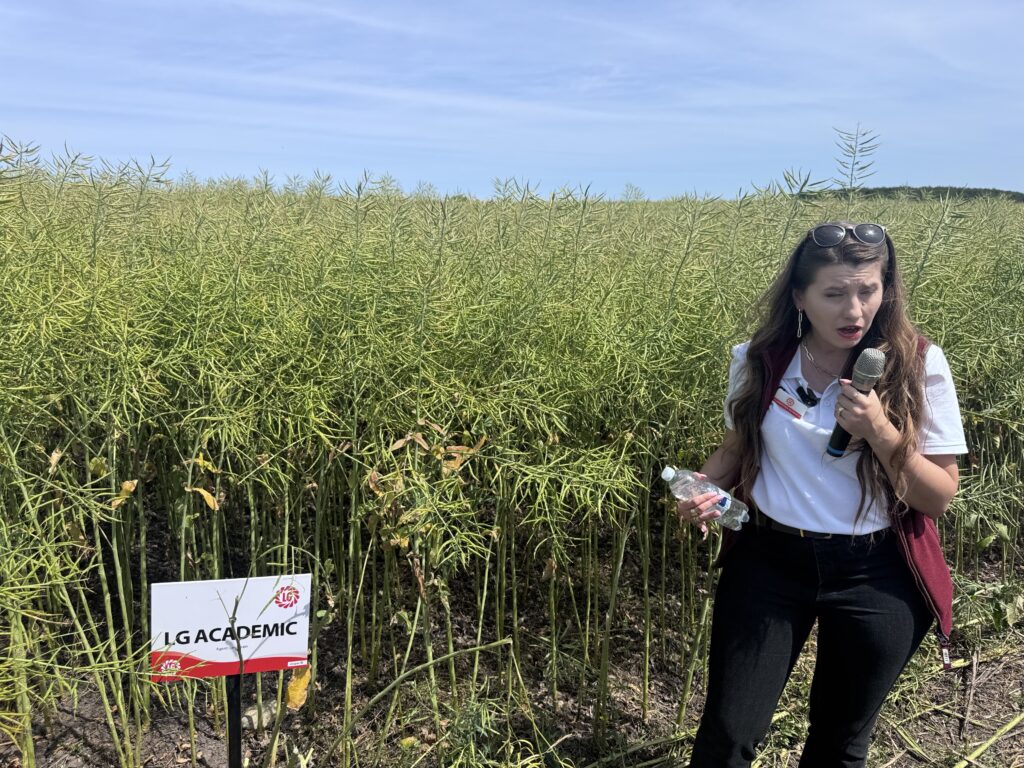
The day was kicked off by Ron Granger, Limagrain UK’s arable technical manager, who has spent four decades working with wheat varieties and guided visitors through the winter wheat and spring barley plots. The host farm belongs to Rob Atkin, a Staffordshire arable and livestock farmer managing 1,300 acres across a diverse rotation, who is actively transitioning from min-till to direct drilling. Heather Oldfield, Limagrain’s cereals and pulses product manager, and Florentina Petrescu, OSR & Sunflower Product Manager at Limagrain, also contributed to the day’s discussions.
Changing policy, changing practices
The backdrop to this debate is stark. The government’s recently published Farming Roadmap 2050 makes it clear that the future of English agriculture lies in “lower input, high technology farming, with a mistrust of fertiliser and a concern about water quality.” So Jeremy Moody, secretary and adviser to the Central Association of Agricultural Valuers (CAAV), said recently, as he warned that farmers must prepare for a rising regulatory baseline with “no more money to be paid.”
This policy direction stands in sharp contrast to the methodology underpinning the AHDB Recommended Lists. To achieve recommendation, varieties are tested under high-input, high-tillage systems designed to push genetic yield potential to its absolute limit. As one attendee at the Limagrain event noted, “All the trials are done in high tillage systems. Only high-input systems are tested and the breeders need to get on the recommended lists. So, the question is: Are the recommended lists actually fit for purpose any more in a regen world?”
For farmers adopting direct drilling, min-till or regenerative practices, or those simply trying to cut back on expensive nitrogen, a variety’s performance under 300kg/ha of nitrogen in a heavily cultivated trial plot may offer little relevant insight into how it will behave in a real-world, lower-input rotation.
The reality on the ground
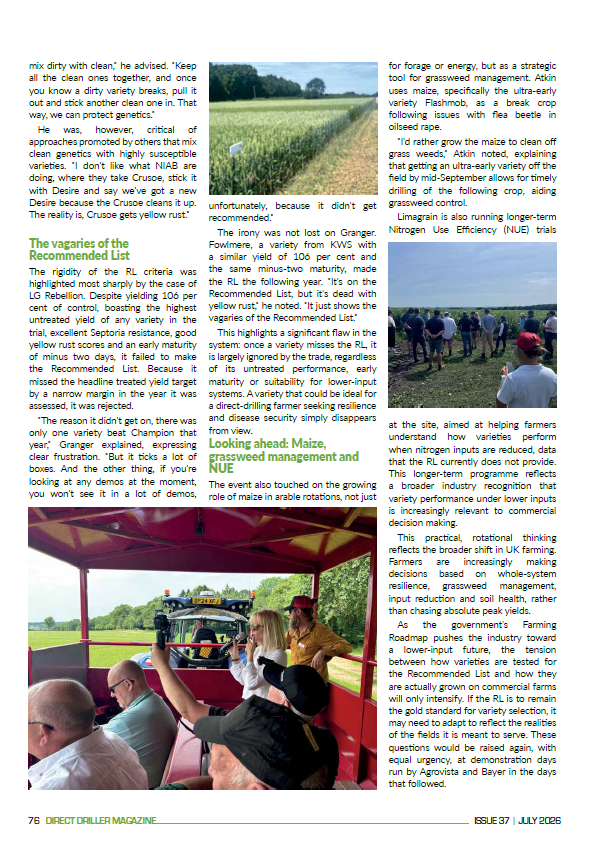
The Staffordshire demo day, hosted by Rob Atkin, provided a practical counterpoint to the RL trial environment. Farming 1,300 acres with a diverse rotation including wheat, barley, beans, oats, maize and hemp, Atkin is transitioning from min-till to direct drilling.
The day featured a direct comparison between direct-drilled and lightly cultivated plots of LG Diablo and LG Aquarius spring barley. While the cultivated plots initially showed faster emergence and bolder early growth, likely due to mineralised nutrients and relieved compaction, the direct-drilled crop caught up entirely as the season progressed. As was pointed out though, the real test will be at harvest to see if the fuel and time spent on that cultivation pass were actually justified.
This is exactly the kind of nuance the RL struggles to capture. Limagrain explained that their new farmer-led Demo Farm network aims to bridge this gap by putting varieties “into real farming systems, managed by farmers making commercial decisions every day.”
The yellow rust battle and the RL squeeze
The limitations of the RL process were further exposed during the winter wheat tour, led by Ron Granger. The dominant talking point was yellow rust, specifically the aggressive “Warrior” strains that have decimated the resistance ratings of several popular varieties over the last two years. The WR15 race of yellow rust, which first appeared in the UK around 2011 and has since diversified into multiple aggressive strains, has rendered the resistance of many popular varieties ineffective. So severe is the breakdown that on the continent, the new strain is no longer referred to as WR15 but as the “Champion race”, after the variety it has hit hardest.
Granger pointed out that nearly 50 per cent of the hard-feed wheat market is currently dominated by varieties susceptible to this breakdown. “Do we have enough new varieties with disease resistance for yellow rust to replace those varieties? No, we don’t,” he stated matter-of-factly. “So the reality is you’re gonna have to stick with some of these dirtier varieties for yellow rust.”
This situation has led to increased interest in variety blends to slow disease spread. Granger was broadly supportive of blending, but only when done correctly. He pointed to the Defiant, Challenger and Rebellion blend being grown on the host farm as a good example: three varieties that are all currently clean for yellow rust, with slightly different genetic backgrounds. “When you put a blend together, don’t mix dirty with clean,” he advised. “Keep all the clean ones together, and once you know a dirty variety breaks, pull it out and stick another clean one in. That way, we can protect genetics.”
He was, however, critical of approaches promoted by others that mix clean genetics with highly susceptible varieties. “I don’t like what NIAB are doing, where they take Crusoe, stick it with Desire and say we’ve got a new Desire because the Crusoe cleans it up. The reality is, Crusoe gets yellow rust.”
The vagaries of the Recommended List
The rigidity of the RL criteria was highlighted most sharply by the case of LG Rebellion. Despite yielding 106 per cent of control, boasting the highest untreated yield of any variety in the trial, excellent Septoria resistance, good yellow rust scores and an early maturity of minus two days, it failed to make the Recommended List. Because it missed the headline treated yield target by a narrow margin in the year it was assessed, it was rejected.
“The reason it didn’t get on, there was only one variety beat Champion that year,” Granger explained, expressing clear frustration. “But it ticks a lot of boxes. And the other thing, if you’re looking at any demos at the moment, you won’t see it in a lot of demos, unfortunately, because it didn’t get recommended.”
The irony was not lost on Granger. Fowlmere, a variety from KWS with a similar yield of 106 per cent and the same minus-two maturity, made the RL the following year. “It’s on the Recommended List, but it’s dead with yellow rust,” he noted. “It just shows the vagaries of the Recommended List.”
This highlights a significant flaw in the system: once a variety misses the RL, it is largely ignored by the trade, regardless of its untreated performance, early maturity or suitability for lower-input systems. A variety that could be ideal for a direct-drilling farmer seeking resilience and disease security simply disappears from view.
Looking ahead: Maize, grassweed management and NUE
The event also touched on the growing role of maize in arable rotations, not just for forage or energy, but as a strategic tool for grassweed management. Atkin uses maize, specifically the ultra-early variety Flashmob, as a break crop following issues with flea beetle in oilseed rape.
“I’d rather grow the maize to clean off grass weeds,” Atkin noted, explaining that getting an ultra-early variety off the field by mid-September allows for timely drilling of the following crop, aiding grassweed control.
Limagrain is also running longer-term Nitrogen Use Efficiency (NUE) trials at the site, aimed at helping farmers understand how varieties perform when nitrogen inputs are reduced, data that the RL currently does not provide. This longer-term programme reflects a broader industry recognition that variety performance under lower inputs is increasingly relevant to commercial decision making.
This practical, rotational thinking reflects the broader shift in UK farming. Farmers are increasingly making decisions based on whole-system resilience, grassweed management, input reduction and soil health, rather than chasing absolute peak yields.
As the government’s Farming Roadmap pushes the industry toward a lower-input future, the tension between how varieties are tested for the Recommended List and how they are actually grown on commercial farms will only intensify. If the RL is to remain the gold standard for variety selection, it may need to adapt to reflect the realities of the fields it is meant to serve. These questions would be raised again, with equal urgency, at demonstration days run by Agrovista and Bayer in the days that followed.