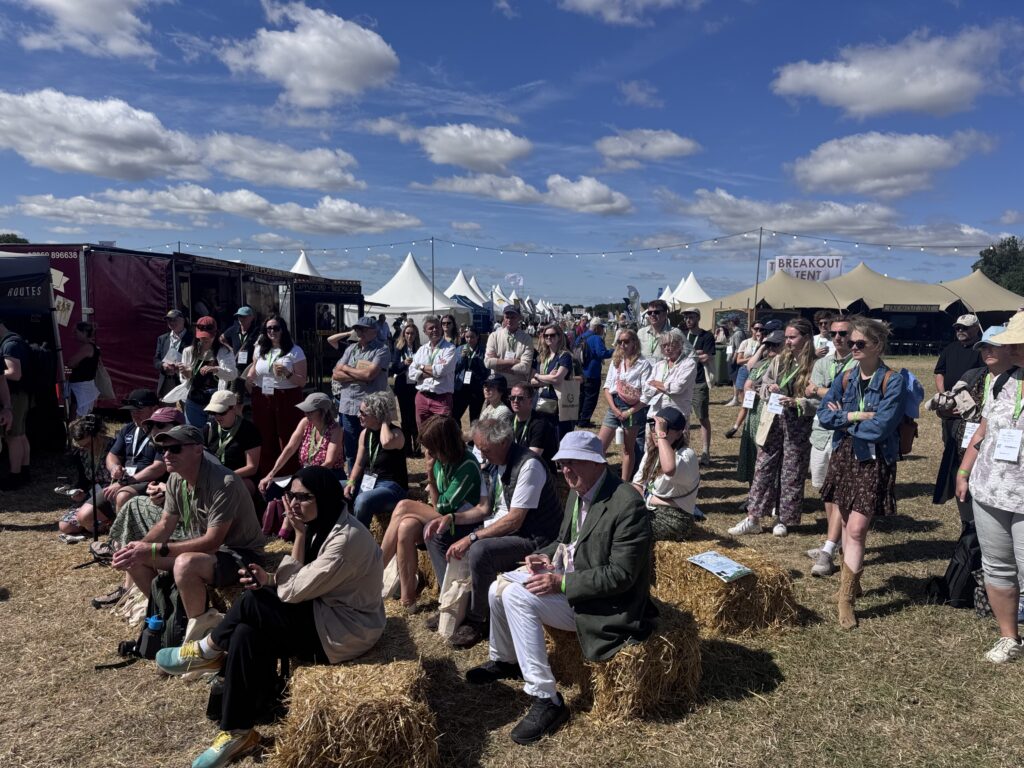
There are few things more powerful in agriculture than a practical demonstration. While charts and graphs can illustrate the benefits of soil health, seeing the physical reality of how water interacts with different farming systems leaves a lasting impression. At Groundswell 2026, the Rainfall Simulator and Slake Test session, hosted by Affinity Water and Hutchinsons, provided a stark, visual reminder of why soil structure and surface cover are the foundations of resilient farming.
The demonstration, introduced by Bethany Eaton and Danny Coffey from Affinity Water alongside Ian Robertson and Cat Dyer from Hutchinsons, took place on a sun-drenched outdoor stage. Yet, the focus was entirely on what happens when the heavens open.
The first line of water treatment
Bethany Eaton and Danny Coffey opened the session by outlining the sheer scale of the water challenge in the southeast of England. Affinity Water supplies nearly 970 million litres of water daily to 3.9 million customers, with 60% of that supply drawn from groundwater sources, primarily the chalk aquifer. Coffey issued a stark warning: without action, the region faces a potential 5 billion litre per day shortage by 2050 due to climate change and population growth.
The connection to farming is direct and critical. Coffey explained that soil acts as the “first line of water treatment”. A healthy soil microbiome breaks down pesticides and cycles nutrients, preventing them from leaching into chalk streams. Furthermore, soil rich in organic matter acts like a sponge, holding water in the landscape rather than allowing it to run off, taking valuable topsoil with it.
The slake test: Structure under pressure
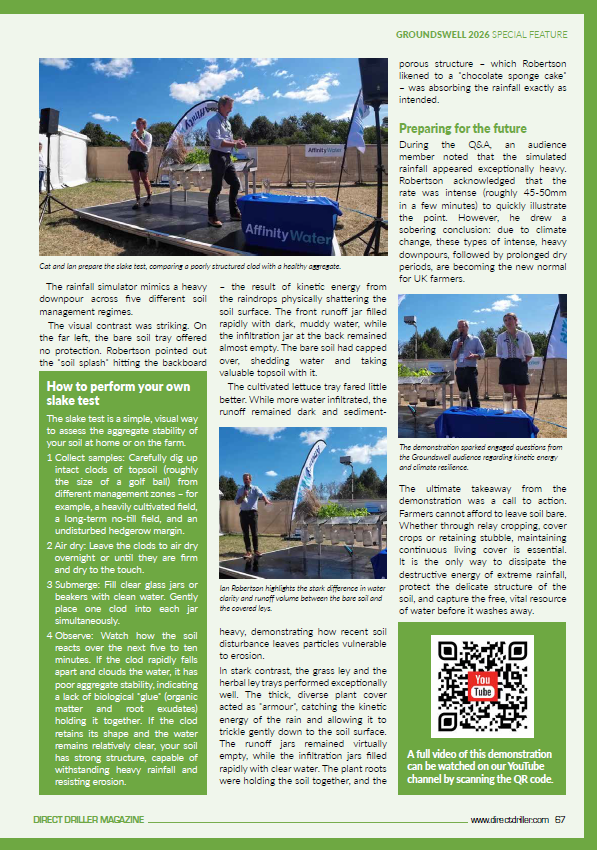
Before turning on the rain, the team introduced the “slake test”. Conducted on stage by Cat Dyer, a specialist soils agronomist, the test is a simple but brutal assessment of soil aggregate stability.
Ian Robertson, Hutchinsons’ Farming Resilience Lead, began by banging two hard, dry clods of soil together, producing a loud clacking noise. He noted that many farmers assume a hard clod means the soil is compacted and requires deep cultivation. The slake test challenges this assumption.
Cat placed a clod of “poor soil” into a clear glass jar of water on the left, and a “better-structured soil” clod into a jar on the right. The results were immediate. The poorly structured soil rapidly “slaked”, collapsing into a muddy heap at the bottom of the jar as water rushed into the pore spaces, blowing the weak aggregates apart. The better-structured soil, held together by glomalin, root exudates and a robust microbial network, maintained its shape, allowing water to gently infiltrate without destroying the clod.
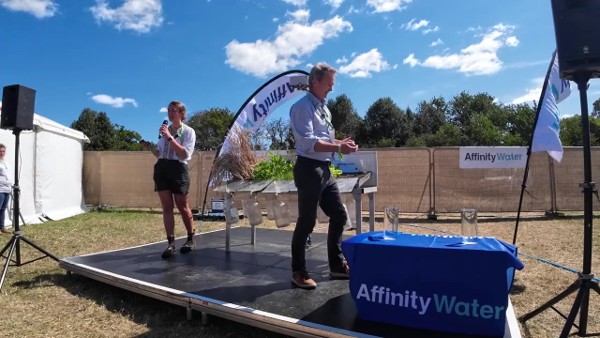
Ian’s message was clear: if a hard clod holds together in water, do not cultivate it. The structure is sound. If it collapses, the structure is poor, and cultivation may be necessary to establish a crop, but the long-term goal must be to rebuild that biological glue. Regenerative farming, he stressed, is not about never cultivating; it is about cultivating “the right amount, in the right place, at the right time.”
The rainfall simulator: Armouring the soil
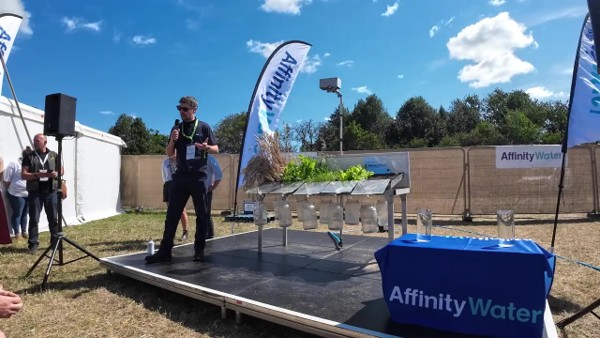
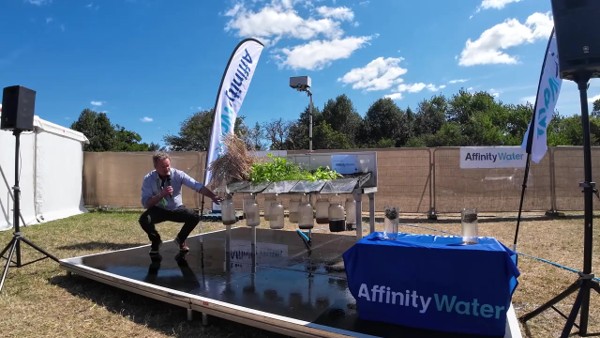
The centrepiece of the session was the rainfall simulator. A metal frame held five slanted trays of soil, each representing a different surface cover: bare soil, cultivated soil with lettuce modules, a one-year-old grass ley, an established herbal ley and a tray of senescing wheat.
As the simulator sprayed the equivalent of a heavy 5mm downpour over the trays, the audience watched two sets of clear collection jars positioned beneath them. The front jars collected surface runoff, while the back jars collected water that successfully infiltrated through the soil profile.
The visual contrast was striking. On the far left, the bare soil tray offered no protection. Robertson pointed out the “soil splash” hitting the backboard – the result of kinetic energy from the raindrops physically shattering the soil surface. The front runoff jar filled rapidly with dark, muddy water, while the infiltration jar at the back remained almost empty. The bare soil had capped over, shedding water and taking valuable topsoil with it.
The cultivated lettuce tray fared little better. While more water infiltrated, the runoff remained dark and sediment-heavy, demonstrating how recent soil disturbance leaves particles vulnerable to erosion.
In stark contrast, the grass ley and the herbal ley trays performed exceptionally well. The thick, diverse plant cover acted as “armour”, catching the kinetic energy of the rain and allowing it to trickle gently down to the soil surface. The runoff jars remained virtually empty, while the infiltration jars filled rapidly with clear water. The plant roots were holding the soil together, and the porous structure – which Robertson likened to a “chocolate sponge cake” – was absorbing the rainfall exactly as intended.
How to perform your own slake test
The slake test is a simple, visual way to assess the aggregate stability of your soil at home or on the farm.
1. Collect samples: Carefully dig up intact clods of topsoil (roughly the size of a golf ball) from different management zones – for example, a heavily cultivated field, a long-term no-till field, and an undisturbed hedgerow margin.
2. Air dry: Leave the clods to air dry overnight or until they are firm and dry to the touch.
3. Submerge: Fill clear glass jars or beakers with clean water. Gently place one clod into each jar simultaneously.
4. Observe: Watch how the soil reacts over the next five to ten minutes. If the clod rapidly falls apart and clouds the water, it has poor aggregate stability, indicating a lack of biological “glue” (organic matter and root exudates) holding it together. If the clod retains its shape and the water remains relatively clear, your soil has strong structure, capable of withstanding heavy rainfall and resisting erosion.
Preparing for the future
During the Q&A, an audience member noted that the simulated rainfall appeared exceptionally heavy. Robertson acknowledged that the rate was intense (roughly 45-50mm in a few minutes) to quickly illustrate the point. However, he drew a sobering conclusion: due to climate change, these types of intense, heavy downpours, followed by prolonged dry periods, are becoming the new normal for UK farmers.
The ultimate takeaway from the demonstration was a call to action. Farmers cannot afford to leave soil bare. Whether through relay cropping, cover crops or retaining stubble, maintaining continuous living cover is essential. It is the only way to dissipate the destructive energy of extreme rainfall, protect the delicate structure of the soil, and capture the free, vital resource of water before it washes away.