Data is rapidly becoming as critical a commodity in agriculture as the crops and livestock we produce. Yet, for many farmers, the push to collect and share environmental metrics feels less like an opportunity and more like an administrative burden. At Groundswell 2026, the Agriculture and Horticulture Development Board (AHDB) hosted a session titled Baselining and Environmental Data to tackle this very issue.
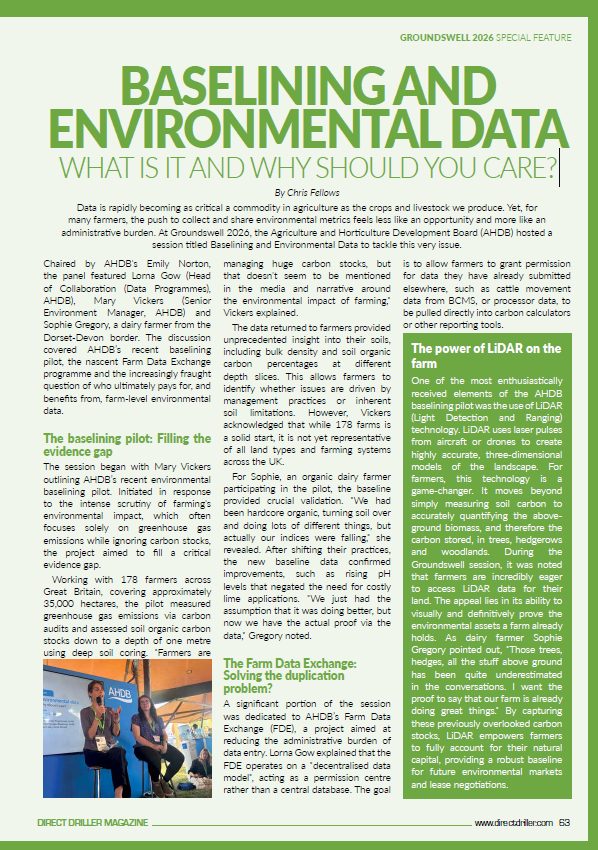
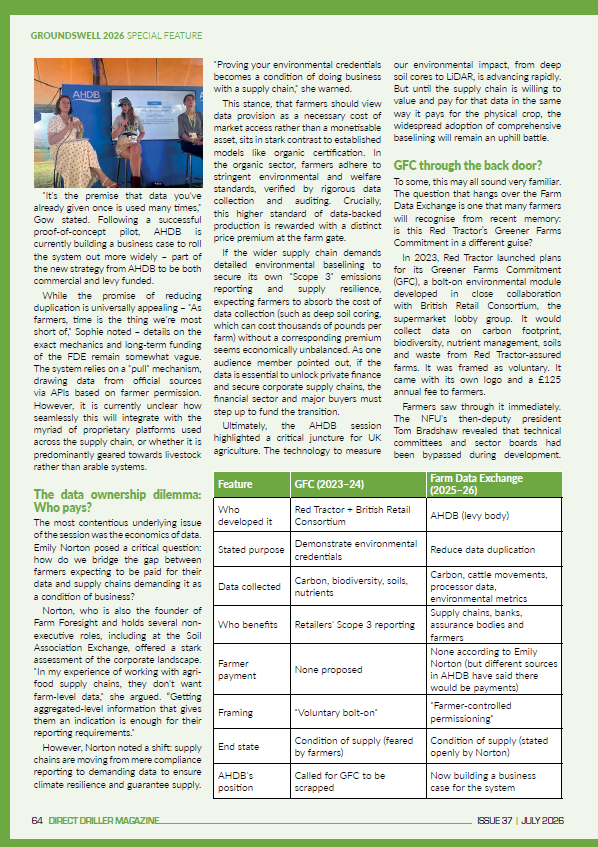
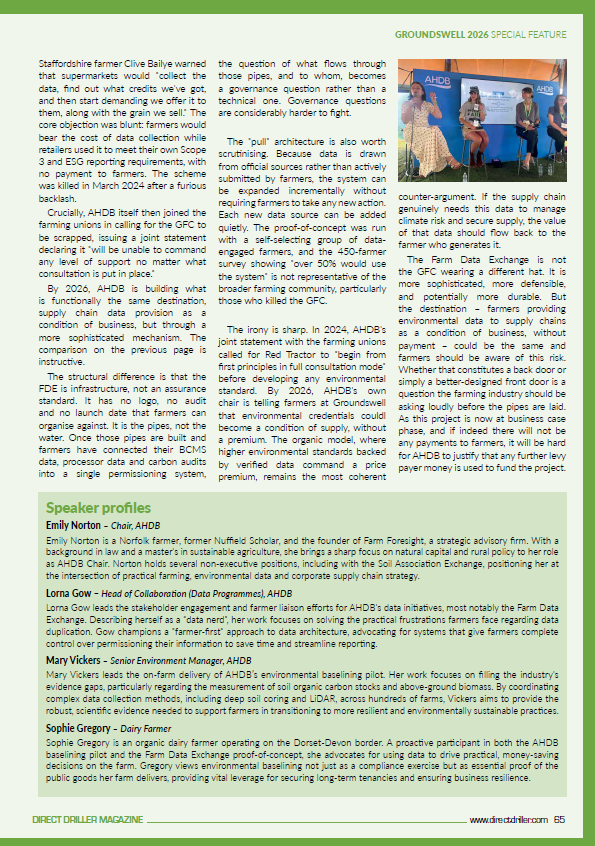
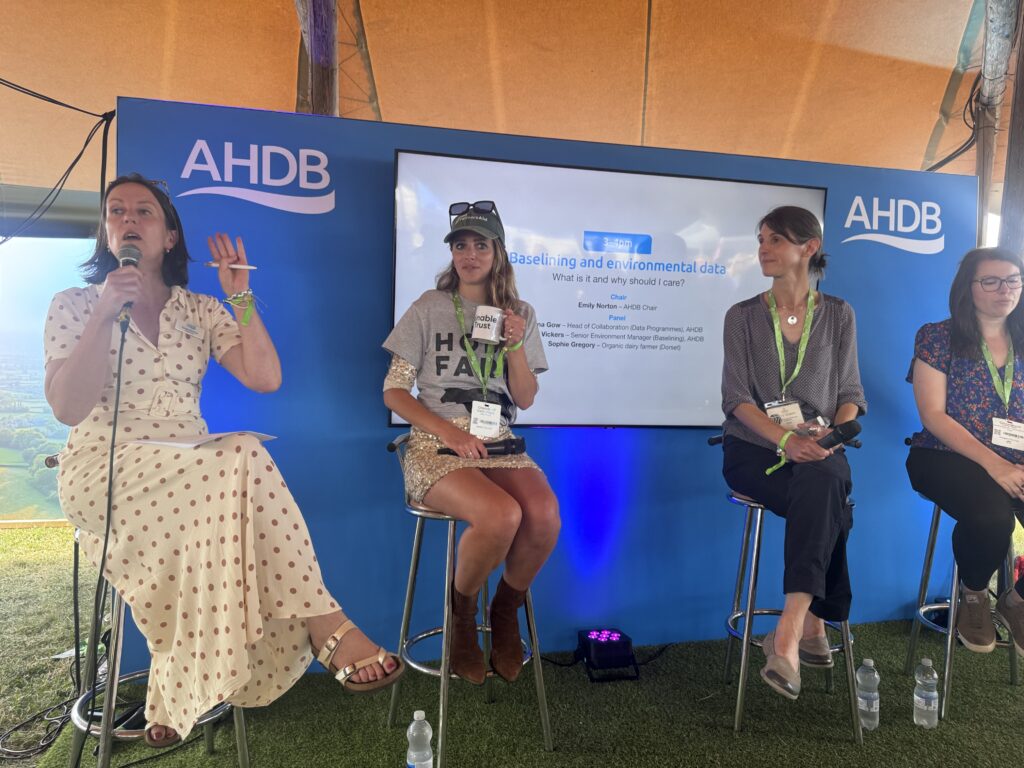
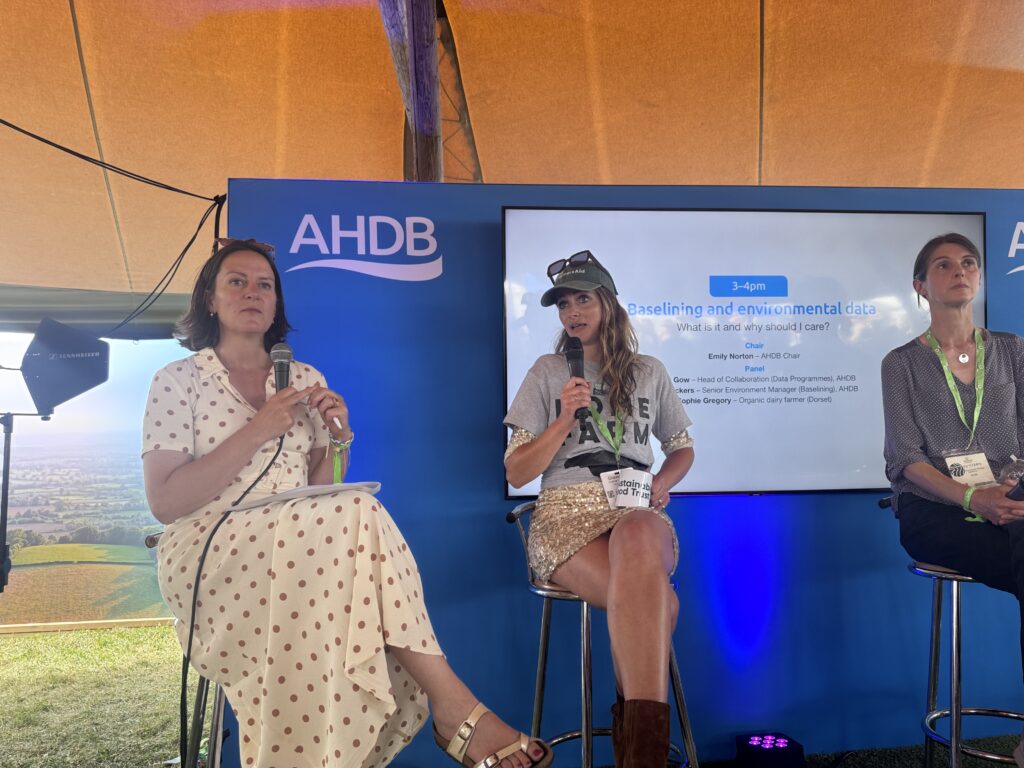
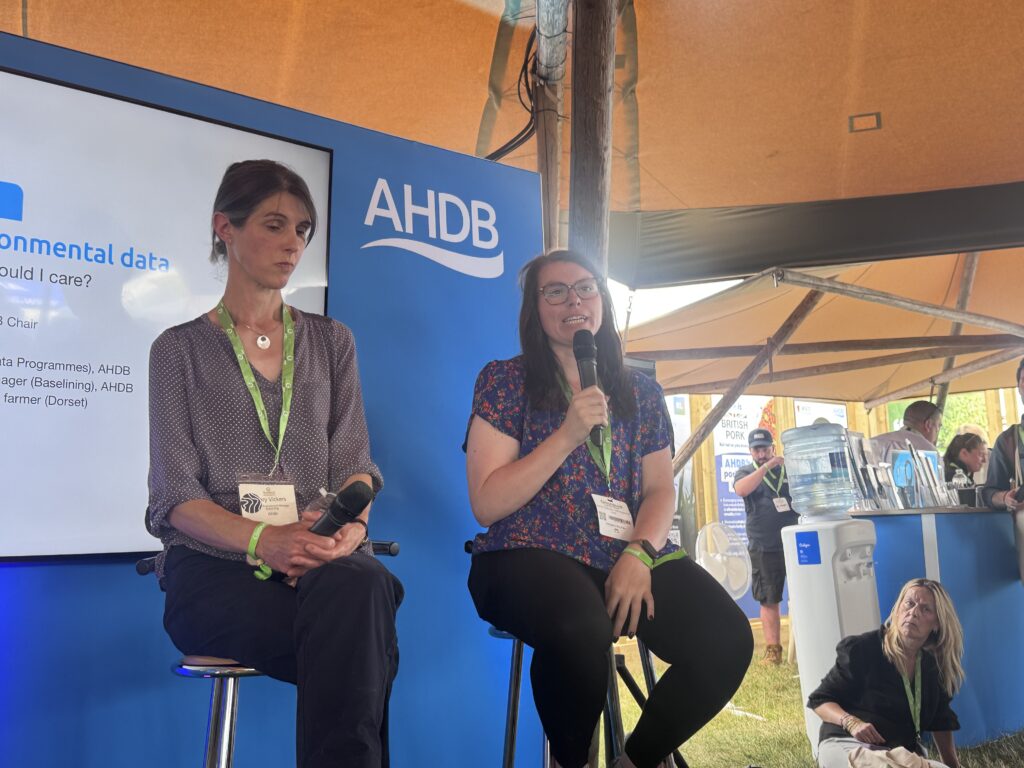
Chaired by AHDB’s Emily Norton, the panel featured Lorna Gow (Head of Collaboration (Data Programmes), AHDB), Mary Vickers (Senior Environment Manager, AHDB) and Sophie Gregory, a dairy farmer from the Dorset-Devon border. The discussion covered AHDB’s recent baselining pilot, the nascent Farm Data Exchange programme and the increasingly fraught question of who ultimately pays for, and benefits from, farm-level environmental data.
The baselining pilot: Filling the evidence gap
The session began with Mary Vickers outlining AHDB’s recent environmental baselining pilot. Initiated in response to the intense scrutiny of farming’s environmental impact, which often focuses solely on greenhouse gas emissions while ignoring carbon stocks, the project aimed to fill a critical evidence gap.
Working with 178 farmers across Great Britain, covering approximately 35,000 hectares, the pilot measured greenhouse gas emissions via carbon audits and assessed soil organic carbon stocks down to a depth of one metre using deep soil coring. “Farmers are managing huge carbon stocks, but that doesn’t seem to be mentioned in the media and narrative around the environmental impact of farming,” Vickers explained.
The data returned to farmers provided unprecedented insight into their soils, including bulk density and soil organic carbon percentages at different depth slices. This allows farmers to identify whether issues are driven by management practices or inherent soil limitations. However, Vickers acknowledged that while 178 farms is a solid start, it is not yet representative of all land types and farming systems across the UK.
For Sophie, an organic dairy farmer participating in the pilot, the baseline provided crucial validation. “We had been hardcore organic, turning soil over and doing lots of different things, but actually our indices were falling,” she revealed. After shifting their practices, the new baseline data confirmed improvements, such as rising pH levels that negated the need for costly lime applications. “We just had the assumption that it was doing better, but now we have the actual proof via the data,” Gregory noted.
The power of LiDAR on the farm
One of the most enthusiastically received elements of the AHDB baselining pilot was the use of LiDAR (Light Detection and Ranging) technology. LiDAR uses laser pulses from aircraft or drones to create highly accurate, three-dimensional models of the landscape. For farmers, this technology is a game-changer. It moves beyond simply measuring soil carbon to accurately quantifying the above-ground biomass, and therefore the carbon stored, in trees, hedgerows and woodlands. During the Groundswell session, it was noted that farmers are incredibly eager to access LiDAR data for their land. The appeal lies in its ability to visually and definitively prove the environmental assets a farm already holds. As dairy farmer Sophie Gregory pointed out, “Those trees, hedges, all the stuff above ground has been quite underestimated in the conversations. I want the proof to say that our farm is already doing great things.” By capturing these previously overlooked carbon stocks, LiDAR empowers farmers to fully account for their natural capital, providing a robust baseline for future environmental markets and lease negotiations.
The Farm Data Exchange: Solving the duplication problem?
A significant portion of the session was dedicated to AHDB’s Farm Data Exchange (FDE), a project aimed at reducing the administrative burden of data entry. Lorna Gow explained that the FDE operates on a “decentralised data model”, acting as a permission centre rather than a central database. The goal is to allow farmers to grant permission for data they have already submitted elsewhere, such as cattle movement data from BCMS, or processor data, to be pulled directly into carbon calculators or other reporting tools.
“It’s the premise that data you’ve already given once is used many times,” Gow stated. Following a successful proof-of-concept pilot, AHDB is currently building a business case to roll the system out more widely – part of the new strategy from AHDB to be both commercial and levy funded.
While the promise of reducing duplication is universally appealing – “As farmers, time is the thing we’re most short of,” Sophie noted – details on the exact mechanics and long-term funding of the FDE remain somewhat vague. The system relies on a “pull” mechanism, drawing data from official sources via APIs based on farmer permission. However, it is currently unclear how seamlessly this will integrate with the myriad of proprietary platforms used across the supply chain, or whether it is predominantly geared towards livestock rather than arable systems.
The data ownership dilemma: Who pays?
The most contentious underlying issue of the session was the economics of data. Emily Norton posed a critical question: how do we bridge the gap between farmers expecting to be paid for their data and supply chains demanding it as a condition of business?
Norton, who is also the founder of Farm Foresight and holds several non-executive roles, including at the Soil Association Exchange, offered a stark assessment of the corporate landscape. “In my experience of working with agrifood supply chains, they don’t want farm-level data,” she argued. “Getting aggregated-level information that gives them an indication is enough for their reporting requirements.”
However, Norton noted a shift: supply chains are moving from mere compliance reporting to demanding data to ensure climate resilience and guarantee supply. “Proving your environmental credentials becomes a condition of doing business with a supply chain,” she warned.
This stance, that farmers should view data provision as a necessary cost of market access rather than a monetisable asset, sits in stark contrast to established models like organic certification. In the organic sector, farmers adhere to stringent environmental and welfare standards, verified by rigorous data collection and auditing. Crucially, this higher standard of data-backed production is rewarded with a distinct price premium at the farm gate.
If the wider supply chain demands detailed environmental baselining to secure its own “Scope 3” emissions reporting and supply resilience, expecting farmers to absorb the cost of data collection (such as deep soil coring, which can cost thousands of pounds per farm) without a corresponding premium seems economically unbalanced. As one audience member pointed out, if the data is essential to unlock private finance and secure corporate supply chains, the financial sector and major buyers must step up to fund the transition.
Ultimately, the AHDB session highlighted a critical juncture for UK agriculture. The technology to measure our environmental impact, from deep soil cores to LiDAR, is advancing rapidly. But until the supply chain is willing to value and pay for that data in the same way it pays for the physical crop, the widespread adoption of comprehensive baselining will remain an uphill battle.
GFC through the back door?
To some, this may all sound very familiar. The question that hangs over the Farm Data Exchange is one that many farmers will recognise from recent memory: is this Red Tractor’s Greener Farms Commitment in a different guise?
In 2023, Red Tractor launched plans for its Greener Farms Commitment (GFC), a bolt-on environmental module developed in close collaboration with British Retail Consortium, the supermarket lobby group. It would collect data on carbon footprint, biodiversity, nutrient management, soils and waste from Red Tractor-assured farms. It was framed as voluntary. It came with its own logo and a £125 annual fee to farmers.
Farmers saw through it immediately. The NFU’s then-deputy president Tom Bradshaw revealed that technical committees and sector boards had been bypassed during development. Staffordshire farmer Clive Bailye warned that supermarkets would “collect the data, find out what credits we’ve got, and then start demanding we offer it to them, along with the grain we sell.” The core objection was blunt: farmers would bear the cost of data collection while retailers used it to meet their own Scope 3 and ESG reporting requirements, with no payment to farmers. The scheme was killed in March 2024 after a furious backlash.
Crucially, AHDB itself then joined the farming unions in calling for the GFC to be scrapped, issuing a joint statement declaring it “will be unable to command any level of support no matter what consultation is put in place.”
By 2026, AHDB is building what is functionally the same destination, supply chain data provision as a condition of business, but through a more sophisticated mechanism. The comparison below is instructive.
| Feature | GFC (2023–24) | Farm Data Exchange (2025–26) |
|---|---|---|
| Who developed it | Red Tractor + British Retail Consortium | AHDB (levy body) |
| Stated purpose | Demonstrate environmental credentials | Reduce data duplication |
| Data collected | Carbon, biodiversity, soils, nutrients | Carbon, cattle movements, processor data, environmental metrics |
| Who benefits | Retailers’ Scope 3 reporting | Supply chains, banks, assurance bodies and farmers |
| Farmer payment | None proposed | None according to Emily Norton (but different sources in AHDB have said there would be payments) |
| Framing | “Voluntary bolt-on” | “Farmer-controlled permissioning” |
| End state | Condition of supply (feared by farmers) | Condition of supply (stated openly by Norton) |
| AHDB’s position | Called for GFC to be scrapped | Now building a business case for the system |
The structural difference is that the FDE is infrastructure, not an assurance standard. It has no logo, no audit and no launch date that farmers can organise against. It is the pipes, not the water. Once those pipes are built and farmers have connected their BCMS data, processor data and carbon audits into a single permissioning system, the question of what flows through those pipes, and to whom, becomes a governance question rather than a technical one. Governance questions are considerably harder to fight.
The “pull” architecture is also worth scrutinising. Because data is drawn from official sources rather than actively submitted by farmers, the system can be expanded incrementally without requiring farmers to take any new action. Each new data source can be added quietly. The proof-of-concept was run with a self-selecting group of data-engaged farmers, and the 450-farmer survey showing “over 50% would use the system” is not representative of the broader farming community, particularly those who killed the GFC.
The irony is sharp. In 2024, AHDB’s joint statement with the farming unions called for Red Tractor to “begin from first principles in full consultation mode” before developing any environmental standard. By 2026, AHDB’s own chair is telling farmers at Groundswell that environmental credentials could become a condition of supply, without a premium. The organic model, where higher environmental standards backed by verified data command a price premium, remains the most coherent counter-argument. If the supply chain genuinely needs this data to manage climate risk and secure supply, the value of that data should flow back to the farmer who generates it.
The Farm Data Exchange is not the GFC wearing a different hat. It is more sophisticated, more defensible, and potentially more durable. But the destination – farmers providing environmental data to supply chains as a condition of business, without payment – could be the same and farmers should be aware of this risk. Whether that constitutes a back door or simply a better-designed front door is a question the farming industry should be asking loudly before the pipes are laid. As this project is now at business case phase, and if indeed there will not be any payments to farmers, it will be hard for AHDB to justify that any further levy payer money is used to fund the project.
Speaker profiles
Emily Norton – Chair, AHDB
Emily Norton is a Norfolk farmer, former Nuffield Scholar, and the founder of Farm Foresight, a strategic advisory firm. With a background in law and a master’s in sustainable agriculture, she brings a sharp focus on natural capital and rural policy to her role as AHDB Chair. Norton holds several non-executive positions, including with the Soil Association Exchange, positioning her at the intersection of practical farming, environmental data and corporate supply chain strategy.
Lorna Gow – Head of Collaboration (Data Programmes), AHDB
Lorna Gow leads the stakeholder engagement and farmer liaison efforts for AHDB’s data initiatives, most notably the Farm Data Exchange. Describing herself as a “data nerd”, her work focuses on solving the practical frustrations farmers face regarding data duplication. Gow champions a “farmer-first” approach to data architecture, advocating for systems that give farmers complete control over permissioning their information to save time and streamline reporting.
Mary Vickers – Senior Environment Manager, AHDB
Mary Vickers leads the on-farm delivery of AHDB’s environmental baselining pilot. Her work focuses on filling the industry’s evidence gaps, particularly regarding the measurement of soil organic carbon stocks and above-ground biomass. By coordinating complex data collection methods, including deep soil coring and LiDAR, across hundreds of farms, Vickers aims to provide the robust, scientific evidence needed to support farmers in transitioning to more resilient and environmentally sustainable practices.
Sophie Gregory – Dairy Farmer
Sophie Gregory is an organic dairy farmer operating on the Dorset-Devon border. A proactive participant in both the AHDB baselining pilot and the Farm Data Exchange proof-of-concept, she advocates for using data to drive practical, money-saving decisions on the farm. Gregory views environmental baselining not just as a compliance exercise but as essential proof of the public goods her farm delivers, providing vital leverage for securing long-term tenancies and ensuring business resilience.