Written by Bill Young
For over 40 years, the arable sector has been treading water. While livestock and horticulture enterprises have seen vast improvements in productivity, cereal yields have remained largely stagnant. At the same time, the costs of production have risen sharply and disproportionately. The only savings in this key sector have come through economies of scale, larger equipment, better technology and reduced labour costs. The inconvenient truth is that many cereal yields today are no better than they were in the 1980s.
In that same period, independent evidence has charted a steep decline in habitat, biodiversity, and pollinators, resulting in a fall in wildlife numbers and species across many areas. Coupled with this is the decline in soil health, which has exacerbated the situation and contributed to flatlining yields. This stands in stark contrast to milk yields and livestock growth rates, which have outperformed their arable counterparts over the same period.
As support mechanisms change and the era of direct subsidies draws to a close, there is a recognised need to rethink the way we farm. The Sustainable Regenerative Agriculture Scheme (SRAS) has been written in the genuine belief that it is possible to increase food production while simultaneously protecting the environment, enhancing animal welfare and increasing biodiversity. This is not just about producing more food; it is about producing safe, wholesome, nutritious food that meets the expectations of today’s discerning consumer. It is about improving the nutritional content of what we eat and becoming more self-sufficient as a food-producing nation.
The inspiration for this scheme draws heavily on pioneers like Bill Jordan, whose foresight with the Conservation Grade Scheme laid the foundations for regenerative farming as we know it today. It also recognises the drive of organisations like The Green Farm Collective, who recognised earlier than most the need to rethink farming to break yield plateaux and meet increasing demand. SRAS builds on the successes and good practice of the past to take agricultural production to the next level.
Central to this thinking is a conviction that the way we measure agricultural success must change. Working alongside Rob Ward and David Rose through an organisation called Vitagri, the SRAS is grounded in the belief that nutrient content from crops, milk and meat produced from more fertile and friable soils will be demonstrably superior to that from depleted, high-input systems. The groundbreaking work being done in this field is startling. In the future, nutrient content per hectare may become more important than overall yield. The number of people a crop can healthily and efficiently feed, and its calorific and micronutrient value, may ultimately prove a more meaningful measure of farm output and profitability than tonnes per hectare alone.
The scope and mission
The SRAS mission is clear: to use collective knowledge, experience and expertise to create a scheme that shapes the future of farming. The goal is to increase the availability of regional food sources while increasing biodiversity, improving soil health, and elevating livestock welfare standards through sustainable mixed farming.
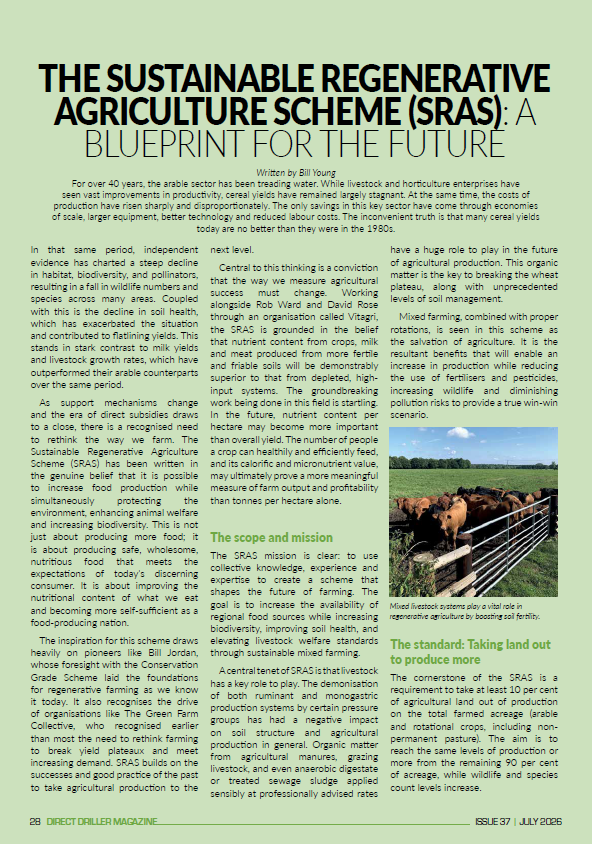
A central tenet of SRAS is that livestock has a key role to play. The demonisation of both ruminant and monogastric production systems by certain pressure groups has had a negative impact on soil structure and agricultural production in general. Organic matter from agricultural manures, grazing livestock, and even anaerobic digestate or treated sewage sludge applied sensibly at professionally advised rates have a huge role to play in the future of agricultural production. This organic matter is the key to breaking the wheat plateau, along with unprecedented levels of soil management.
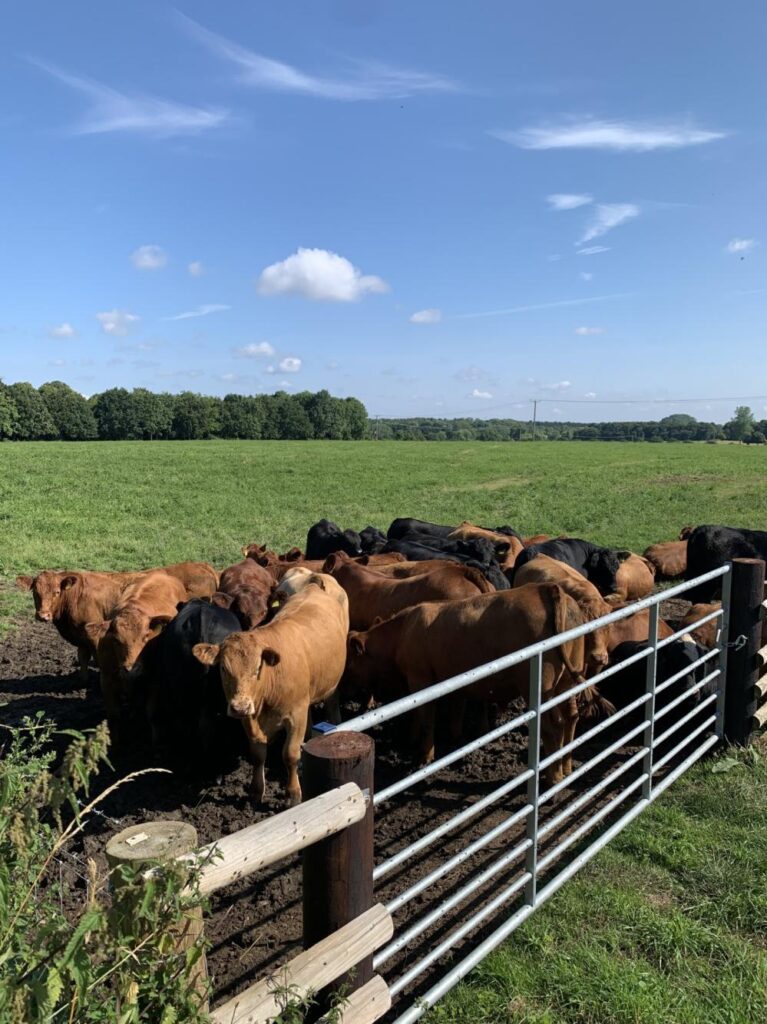
Mixed farming, combined with proper rotations, is seen in this scheme as the salvation of agriculture. It is the resultant benefits that will enable an increase in production while reducing the use of fertilisers and pesticides, increasing wildlife and diminishing pollution risks to provide a true win-win scenario.
The standard: Taking land out to produce more
The cornerstone of the SRAS is a requirement to take at least 10 per cent of agricultural land out of production on the total farmed acreage (arable and rotational crops, including non-permanent pasture). The aim is to reach the same levels of production or more from the remaining 90 per cent of acreage, while wildlife and species count levels increase.
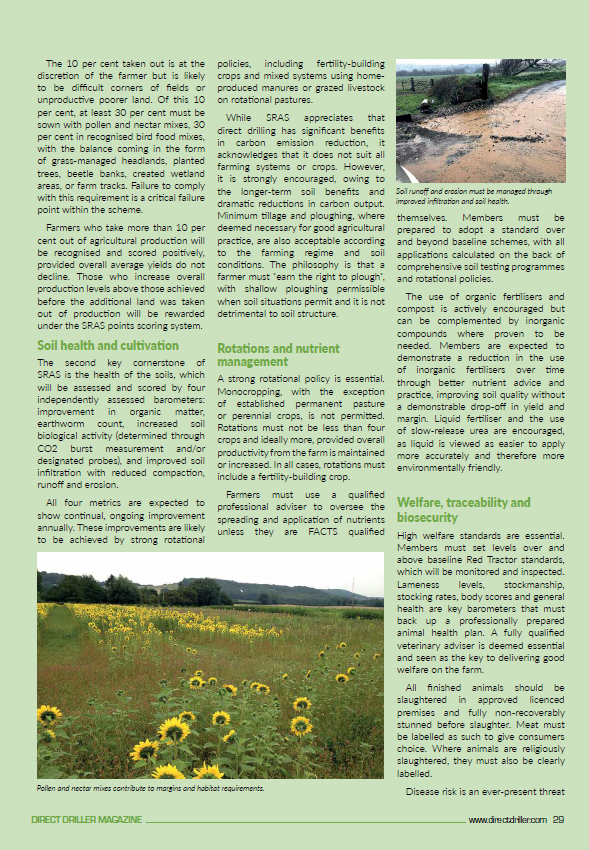
The 10 per cent taken out is at the discretion of the farmer but is likely to be difficult corners of fields or unproductive poorer land. Of this 10 per cent, at least 30 per cent must be sown with pollen and nectar mixes, 30 per cent in recognised bird food mixes, with the balance coming in the form of grass-managed headlands, planted trees, beetle banks, created wetland areas, or farm tracks. Failure to comply with this requirement is a critical failure point within the scheme.
Farmers who take more than 10 per cent out of agricultural production will be recognised and scored positively, provided overall average yields do not decline. Those who increase overall production levels above those achieved before the additional land was taken out of production will be rewarded under the SRAS points scoring system.
Soil health and cultivation
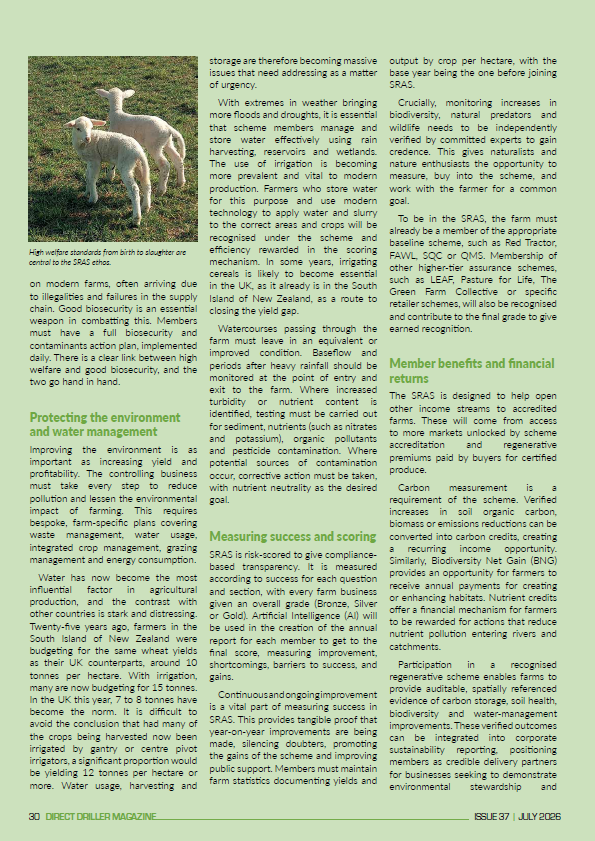
The second key cornerstone of SRAS is the health of the soils, which will be assessed and scored by four independently assessed barometers: improvement in organic matter, earthworm count, increased soil biological activity (determined through CO2 burst measurement and/or designated probes), and improved soil infiltration with reduced compaction, runoff and erosion.
All four metrics are expected to show continual, ongoing improvement annually. These improvements are likely to be achieved by strong rotational policies, including fertility-building crops and mixed systems using home-produced manures or grazed livestock on rotational pastures.
While SRAS appreciates that direct drilling has significant benefits in carbon emission reduction, it acknowledges that it does not suit all farming systems or crops. However, it is strongly encouraged, owing to the longer-term soil benefits and dramatic reductions in carbon output. Minimum tillage and ploughing, where deemed necessary for good agricultural practice, are also acceptable according to the farming regime and soil conditions. The philosophy is that a farmer must “earn the right to plough”, with shallow ploughing permissible when soil situations permit and it is not detrimental to soil structure.
Rotations and nutrient management
A strong rotational policy is essential. Monocropping, with the exception of established permanent pasture or perennial crops, is not permitted. Rotations must not be less than four crops and ideally more, provided overall productivity from the farm is maintained or increased. In all cases, rotations must include a fertility-building crop.
Farmers must use a qualified professional adviser to oversee the spreading and application of nutrients unless they are FACTS qualified themselves. Members must be prepared to adopt a standard over and beyond baseline schemes, with all applications calculated on the back of comprehensive soil testing programmes and rotational policies.
The use of organic fertilisers and compost is actively encouraged but can be complemented by inorganic compounds where proven to be needed. Members are expected to demonstrate a reduction in the use of inorganic fertilisers over time through better nutrient advice and practice, improving soil quality without a demonstrable drop-off in yield and margin. Liquid fertiliser and the use of slow-release urea are encouraged, as liquid is viewed as easier to apply more accurately and therefore more environmentally friendly.
Welfare, traceability and biosecurity
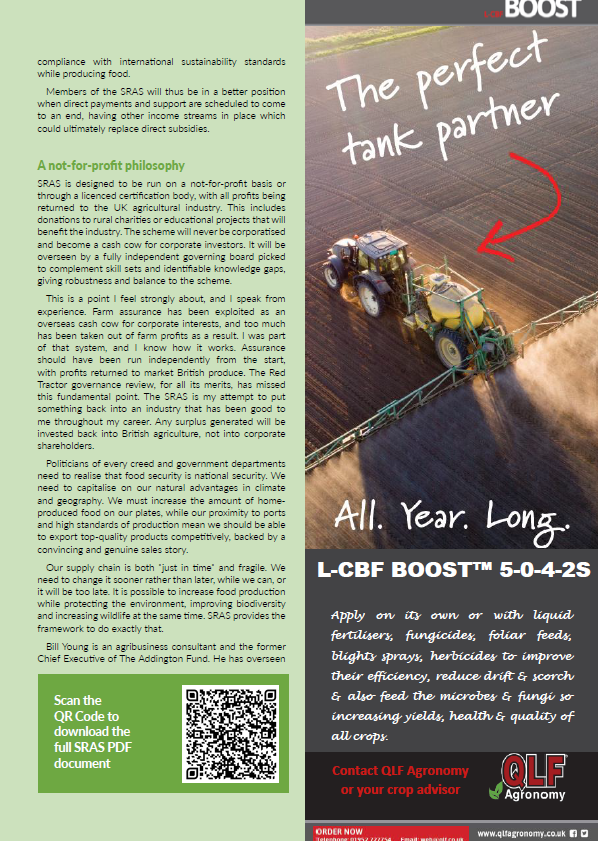
High welfare standards are essential. Members must set levels over and above baseline Red Tractor standards, which will be monitored and inspected. Lameness levels, stockmanship, stocking rates, body scores and general health are key barometers that must back up a professionally prepared animal health plan. A fully qualified veterinary adviser is deemed essential and seen as the key to delivering good welfare on the farm.
All finished animals should be slaughtered in approved licenced premises and fully non-recoverably stunned before slaughter. Meat must be labelled as such to give consumers choice. Where animals are religiously slaughtered, they must also be clearly labelled.
Disease risk is an ever-present threat on modern farms, often arriving due to illegalities and failures in the supply chain. Good biosecurity is an essential weapon in combatting this. Members must have a full biosecurity and contaminants action plan, implemented daily. There is a clear link between high welfare and good biosecurity, and the two go hand in hand.
Protecting the environment and water management
Improving the environment is as important as increasing yield and profitability. The controlling business must take every step to reduce pollution and lessen the environmental impact of farming. This requires bespoke, farm-specific plans covering waste management, water usage, integrated crop management, grazing management and energy consumption.
Water has now become the most influential factor in agricultural production, and the contrast with other countries is stark and distressing. Twenty-five years ago, farmers in the South Island of New Zealand were budgeting for the same wheat yields as their UK counterparts, around 10 tonnes per hectare. With irrigation, many are now budgeting for 15 tonnes. In the UK this year, 7 to 8 tonnes have become the norm. It is difficult to avoid the conclusion that had many of the crops being harvested now been irrigated by gantry or centre pivot irrigators, a significant proportion would be yielding 12 tonnes per hectare or more. Water usage, harvesting and storage are therefore becoming massive issues that need addressing as a matter of urgency.
With extremes in weather bringing more floods and droughts, it is essential that scheme members manage and store water effectively using rain harvesting, reservoirs and wetlands. The use of irrigation is becoming more prevalent and vital to modern production. Farmers who store water for this purpose and use modern technology to apply water and slurry to the correct areas and crops will be recognised under the scheme and efficiency rewarded in the scoring mechanism. In some years, irrigating cereals is likely to become essential in the UK, as it already is in the South Island of New Zealand, as a route to closing the yield gap.
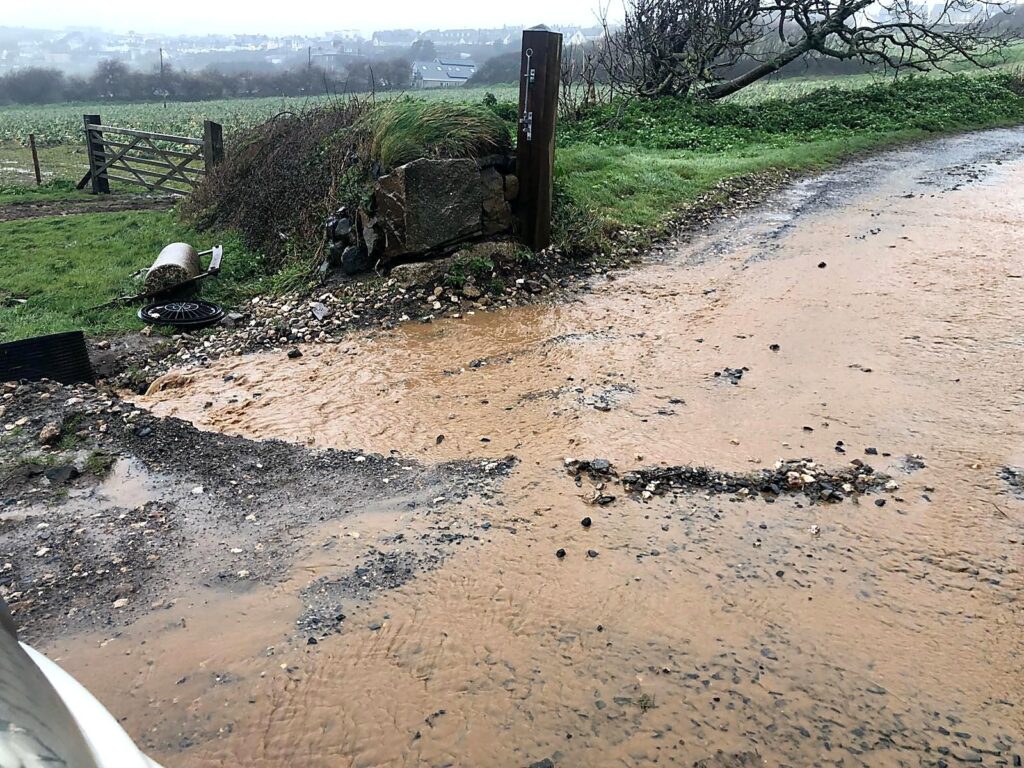
Watercourses passing through the farm must leave in an equivalent or improved condition. Baseflow and periods after heavy rainfall should be monitored at the point of entry and exit to the farm. Where increased turbidity or nutrient content is identified, testing must be carried out for sediment, nutrients (such as nitrates and potassium), organic pollutants and pesticide contamination. Where potential sources of contamination occur, corrective action must be taken, with nutrient neutrality as the desired goal.
Measuring success and scoring
SRAS is risk-scored to give compliance-based transparency. It is measured according to success for each question and section, with every farm business given an overall grade (Bronze, Silver or Gold). Artificial Intelligence (AI) will be used in the creation of the annual report for each member to get to the final score, measuring improvement, shortcomings, barriers to success, and gains.
Continuous and ongoing improvement is a vital part of measuring success in SRAS. This provides tangible proof that year-on-year improvements are being made, silencing doubters, promoting the gains of the scheme and improving public support. Members must maintain farm statistics documenting yields and output by crop per hectare, with the base year being the one before joining SRAS.
Crucially, monitoring increases in biodiversity, natural predators and wildlife needs to be independently verified by committed experts to gain credence. This gives naturalists and nature enthusiasts the opportunity to measure, buy into the scheme, and work with the farmer for a common goal.
To be in the SRAS, the farm must already be a member of the appropriate baseline scheme, such as Red Tractor, FAWL, SQC or QMS. Membership of other higher-tier assurance schemes, such as LEAF, Pasture for Life, The Green Farm Collective or specific retailer schemes, will also be recognised and contribute to the final grade to give earned recognition.
Member benefits and financial returns
The SRAS is designed to help open other income streams to accredited farms. These will come from access to more markets unlocked by scheme accreditation and regenerative premiums paid by buyers for certified produce.
Carbon measurement is a requirement of the scheme. Verified increases in soil organic carbon, biomass or emissions reductions can be converted into carbon credits, creating a recurring income opportunity. Similarly, Biodiversity Net Gain (BNG) provides an opportunity for farmers to receive annual payments for creating or enhancing habitats. Nutrient credits offer a financial mechanism for farmers to be rewarded for actions that reduce nutrient pollution entering rivers and catchments.
Participation in a recognised regenerative scheme enables farms to provide auditable, spatially referenced evidence of carbon storage, soil health, biodiversity and water-management improvements. These verified outcomes can be integrated into corporate sustainability reporting, positioning members as credible delivery partners for businesses seeking to demonstrate environmental stewardship and compliance with international sustainability standards while producing food.
Members of the SRAS will thus be in a better position when direct payments and support are scheduled to come to an end, having other income streams in place which could ultimately replace direct subsidies.
A not-for-profit philosophy
SRAS is designed to be run on a not-for-profit basis or through a licenced certification body, with all profits being returned to the UK agricultural industry. This includes donations to rural charities or educational projects that will benefit the industry. The scheme will never be corporatised and become a cash cow for corporate investors. It will be overseen by a fully independent governing board picked to complement skill sets and identifiable knowledge gaps, giving robustness and balance to the scheme.
This is a point I feel strongly about, and I speak from experience. Farm assurance has been exploited as an overseas cash cow for corporate interests, and too much has been taken out of farm profits as a result. I was part of that system, and I know how it works. Assurance should have been run independently from the start, with profits returned to market British produce. The Red Tractor governance review, for all its merits, has missed this fundamental point. The SRAS is my attempt to put something back into an industry that has been good to me throughout my career. Any surplus generated will be invested back into British agriculture, not into corporate shareholders.
Politicians of every creed and government departments need to realise that food security is national security. We need to capitalise on our natural advantages in climate and geography. We must increase the amount of home-produced food on our plates, while our proximity to ports and high standards of production mean we should be able to export top-quality products competitively, backed by a convincing and genuine sales story.
Our supply chain is both “just in time” and fragile. We need to change it sooner rather than later, while we can, or it will be too late. It is possible to increase food production while protecting the environment, improving biodiversity and increasing wildlife at the same time. SRAS provides the framework to do exactly that.
Bill Young is an agribusiness consultant and the former Chief Executive of The Addington Fund.
You can download a full copy of the report here.