I’ll probably get chucked off Direct Driller magazine for admitting this, but I bought a 3m Treffler hoe to prepare our spring crops this year. I wanted to find out how easy it was to avoid using any sprays or fertiliser and grow ultra-low-input crops. As it happened, it turned out to be very easy, albeit quite slow with a three-metre working width. The Treffler does a lovely job of slicing off the heads of the weeds at one or two-inch depths and leaves a nice mulch to stop the soil blow drying out too much. We gave most of the ground two passes, which killed nearly all the plants left by the cattle that had been grazing the cover crops and then drilled beans and heritage wheat (April Bearded) into the moist, undisturbed topsoil.
Of course, that was at the beginning of the drought, but the beans came well, and the wheat came ok, and they both hung on until we got some rain a few weeks later. There’s something very pleasing about companion cropping; both crops seem to help each other along. The recent hot weather has taken the vim out of the beans, with only two or three pods per plant, and the wheat has at most two tillers, but it’ll be worth combining.
We’ve just cut our one field of no-input winter wheat, which yielded a stonking 3.8 tonnes to the hectare. It’s a lovely sample and cost us next to nothing to grow, but I don’t think it makes a lot of financial sense without an organic premium. Interesting though how little disease you get with a five-way variety mix and no nitrogen. We’ve just bought a grain mill so we can add a bit of value to wheat like this; there seems to be a ready market with local bakers, etc looking for a more interesting story to tell their customers – here comes the Grindswell project!
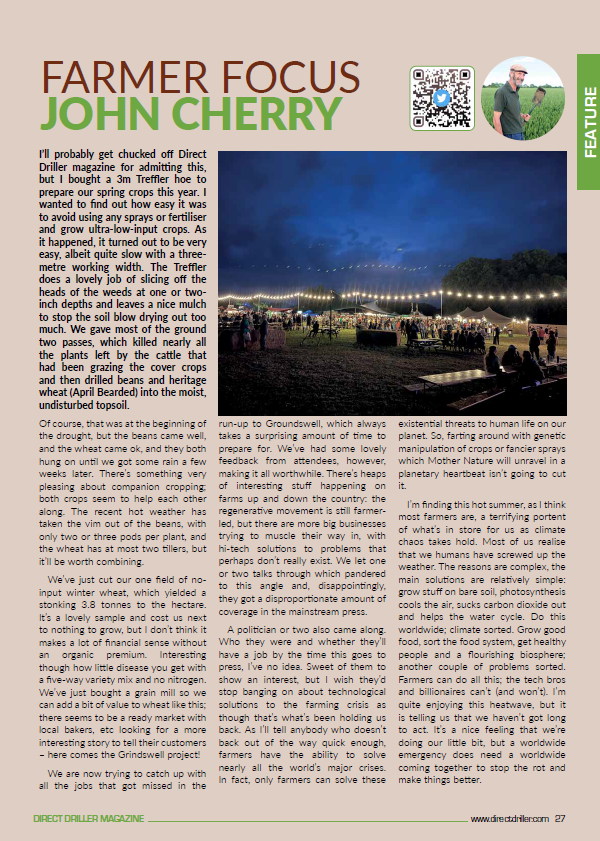
We are now trying to catch up with all the jobs that got missed in the run-up to Groundswell, which always takes a surprising amount of time to prepare for. We’ve had some lovely feedback from attendees, however, making it all worthwhile. There’s heaps of interesting stuff happening on farms up and down the country: the regenerative movement is still farmer-led, but there are more big businesses trying to muscle their way in, with hi-tech solutions to problems that perhaps don’t really exist. We let one or two talks through which pandered to this angle and, disappointingly, they got a disproportionate amount of coverage in the mainstream press.
A politician or two also came along. Who they were and whether they’ll have a job by the time this goes to press, I’ve no idea. Sweet of them to show an interest, but I wish they’d stop banging on about technological solutions to the farming crisis as though that’s what’s been holding us back. As I’ll tell anybody who doesn’t back out of the way quick enough, farmers have the ability to solve nearly all the world’s major crises. In fact, only farmers can solve these existential threats to human life on our planet. So, farting around with genetic manipulation of crops or fancier sprays which Mother Nature will unravel in a planetary heartbeat isn’t going to cut it.
I’m finding this hot summer, as I think most farmers are, a terrifying portent of what’s in store for us as climate chaos takes hold. Most of us realise that we humans have screwed up the weather. The reasons are complex, the main solutions are relatively simple: grow stuff on bare soil, photosynthesis cools the air, sucks carbon dioxide out and helps the water cycle. Do this worldwide; climate sorted. Grow good food, sort the food system, get healthy people and a flourishing biosphere; another couple of problems sorted. Farmers can do all this; the tech bros and billionaires can’t (and won’t). I’m quite enjoying this heatwave, but it is telling us that we haven’t got long to act. It’s a nice feeling that we’re doing our little bit, but a worldwide emergency does need a worldwide coming together to stop the rot and make things better.