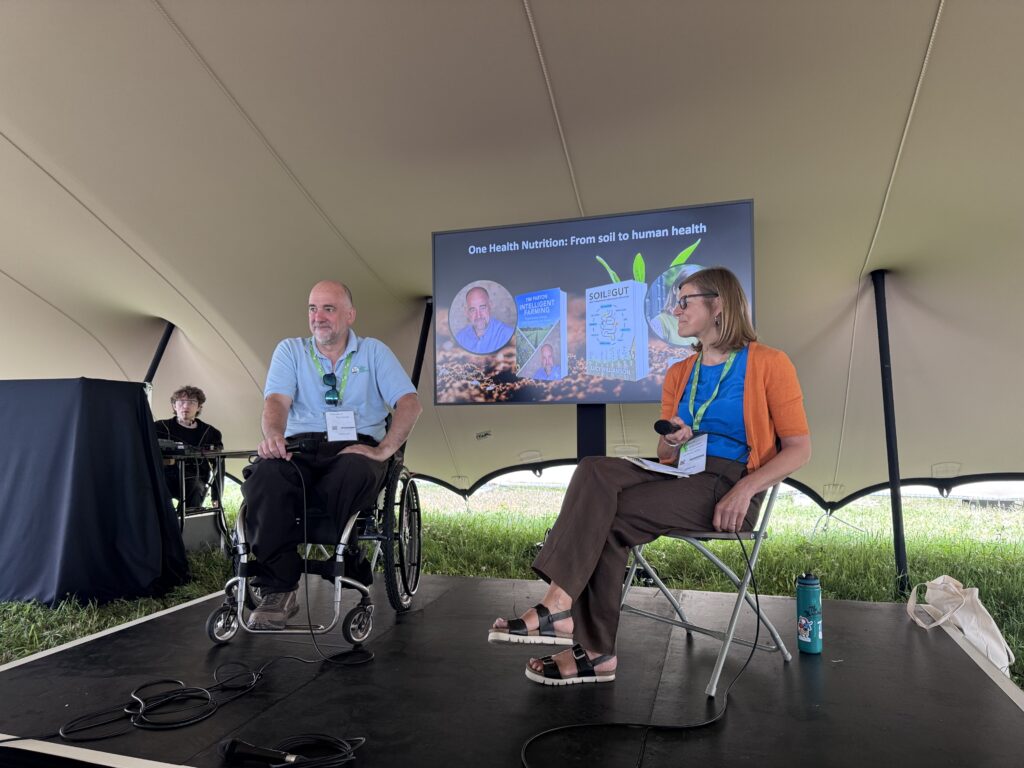
For decades, the agricultural conversation has been dominated by yield, inputs, and the relentless pursuit of volume. But at Groundswell 2026, a different narrative took centre stage; one that connected the microscopic marvels beneath our feet to the trillions of microbes within our own bodies. In a compelling session titled One Health Nutrition: From Soil to Human Health, Direct Driller Farmer Focus writer Tim Parton and public health nutritionist Dr Lucy Williamson explored the profound and undeniable link between regenerative farming and human wellbeing.
The premise was simple but revolutionary: you cannot have a healthy population without healthy soil. As the UK grapples with rising rates of chronic, inflammation-driven diseases, the drive for better diets is shining a new light on how we produce our food. For farmers like Tim, this is not just an agronomic shift; it is a fundamental reimagining of agriculture as the frontline of public health.
Intelligent farming: Healing the soil to heal ourselves
Tim Parton’s journey into biological farming was not born out of a desire to chase trends, but out of a profound personal crisis. Having managed land conventionally for years, relying heavily on synthetic inputs, a period of severe anxiety and depression forced him to re-evaluate everything, including the food he was eating.
“I went through mental depression and anxiety, and at the time it was bloody horrible,” Tim shared candidly with the Groundswell audience. “But it was probably one of the best things that ever happened to me because it made me learn a lot about myself.”
Choosing to address his health through targeted nutrition rather than solely relying on medication, Tim experienced a rapid recovery. This personal transformation ignited a professional one. He began to question the logic of applying toxic chemicals to the crops he was growing for human consumption. “If you’d have asked me in my mid-twenties, I was a big chemical fanatic,” he admitted. “But the more nitrogen we put on our soils, the more weak cells we create in that plant. That plant isn’t photosynthesising properly, and then you’re going to get insect attack, you’re going to get disease attack.”
Tim’s approach, which he details in his new book Intelligent Farming, revolves around understanding and supporting the plant’s natural immune system. By focusing on soil biology and plant nutrition, frequently using sap analysis to monitor his crops “like top athletes”, he has successfully eliminated insecticides for over a decade and fungicides for seven years.
“Soil is life,” Tim emphasised. “When you start to get those fungal connections, that mycorrhizal network, the nutrient density of the food goes through the roof. We’ve got so many health problems in our community – cancers, dementia, autism – and nobody is asking why. It all comes back to the soil.”
Mimicking nature: The role of livestock and compost
While integrating livestock is a core tenet of many regenerative systems, Tim’s approach demonstrates that there is more than one way to achieve biological diversity. Managing an arable estate without his own livestock, he initially brought in grazing sheep. However, the economics and nutrient export didn’t stack up for his specific system.
“When I added up how much nutrition a lamb takes up over a six or eight-week period, it was a lot,” Tim explained. “They were taking off far more nutrition than what I was being paid for.” Furthermore, grazing cover crops in dry springs left the soil exposed, reducing subsequent cash crop yields compared to areas where he had used a crimper roller to create a protective thatch.
Instead of grazing, Tim mimics the biological impact of livestock through extensive composting. He creates diverse fungal and bacterial composts, extracts the microbes and applies them directly to the soil via a liquid applicator on his drill. Combined with diverse cover crops, always featuring at least eight different plant families, this ensures the soil receives the biological stimulation it needs to function naturally.
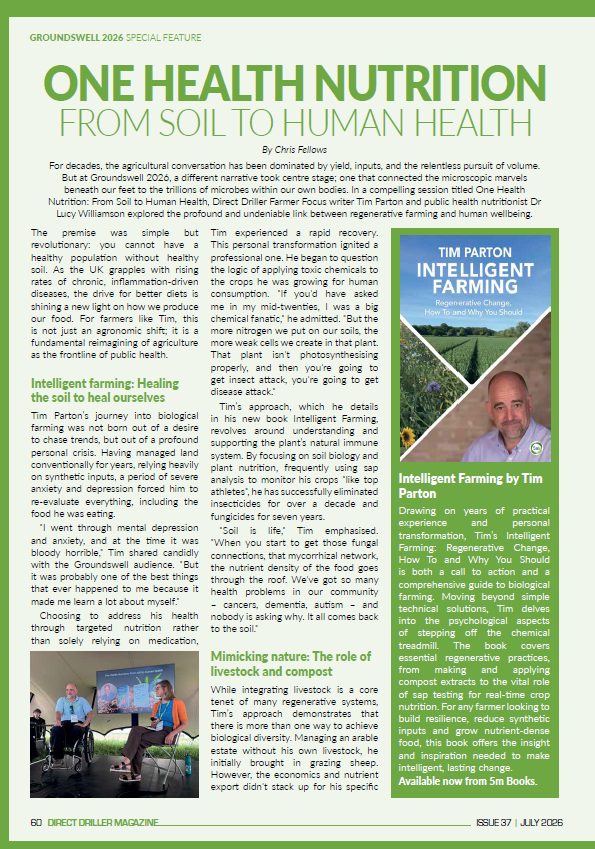
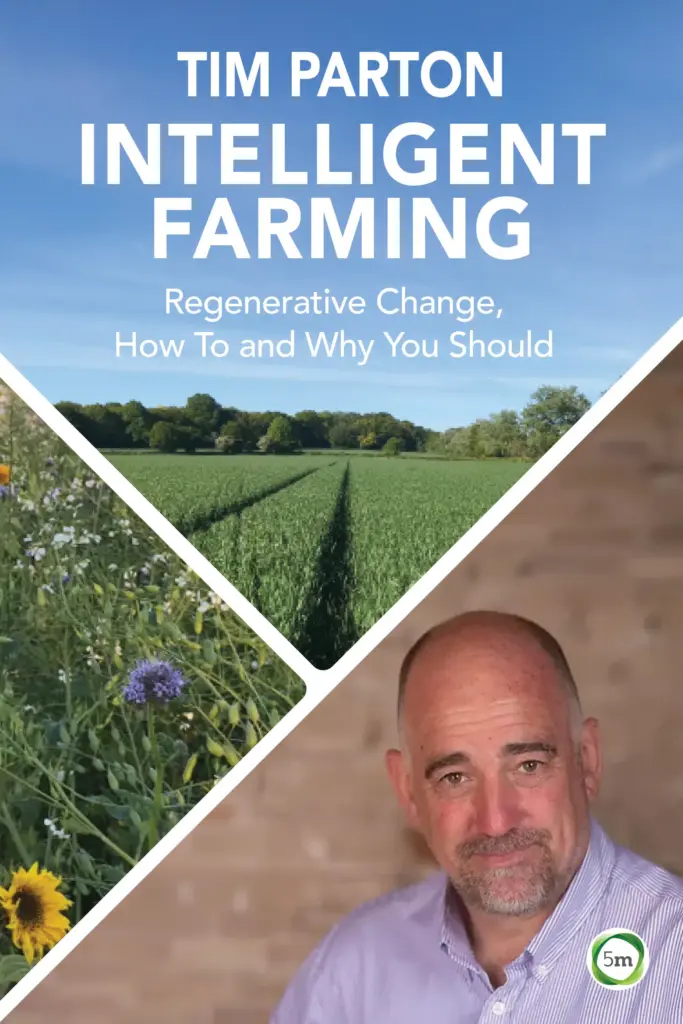
Intelligent Farming by Tim Parton
Drawing on years of practical experience and personal transformation, Tim’s Intelligent Farming: Regenerative Change, How To and Why You Should is both a call to action and a comprehensive guide to biological farming. Moving beyond simple technical solutions, Tim delves into the psychological aspects of stepping off the chemical treadmill. The book covers essential regenerative practices, from making and applying compost extracts to the vital role of sap testing for real-time crop nutrition. For any farmer looking to build resilience, reduce synthetic inputs and grow nutrient-dense food, this book offers the insight and inspiration needed to make intelligent, lasting change. Available now from 5m Books.
The gut-soil connection
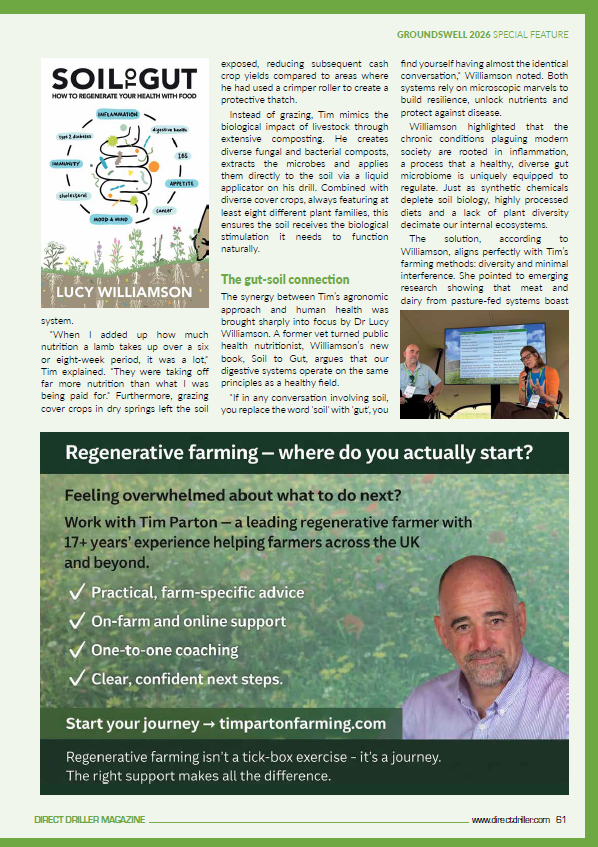
The synergy between Tim’s agronomic approach and human health was brought sharply into focus by Dr Lucy Williamson. A former vet turned public health nutritionist, Williamson’s new book, Soil to Gut, argues that our digestive systems operate on the same principles as a healthy field.
“If in any conversation involving soil, you replace the word ‘soil’ with ‘gut’, you find yourself having almost the identical conversation,” Williamson noted. Both systems rely on microscopic marvels to build resilience, unlock nutrients and protect against disease.
Williamson highlighted that the chronic conditions plaguing modern society are rooted in inflammation, a process that a healthy, diverse gut microbiome is uniquely equipped to regulate. Just as synthetic chemicals deplete soil biology, highly processed diets and a lack of plant diversity decimate our internal ecosystems.
The solution, according to Williamson, aligns perfectly with Tim’s farming methods: diversity and minimal interference. She pointed to emerging research showing that meat and dairy from pasture-fed systems boast significantly healthier fat profiles, rich in anti-inflammatory omega-3s. These are the very fats our gut microbes need to thrive.
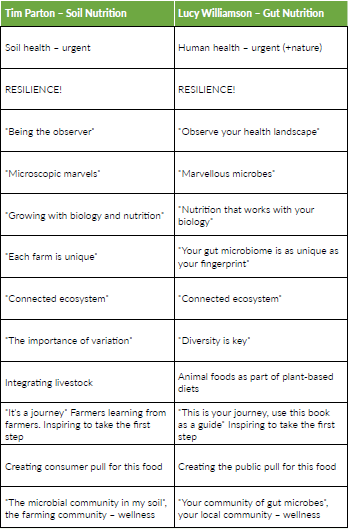
A shared language of resilience
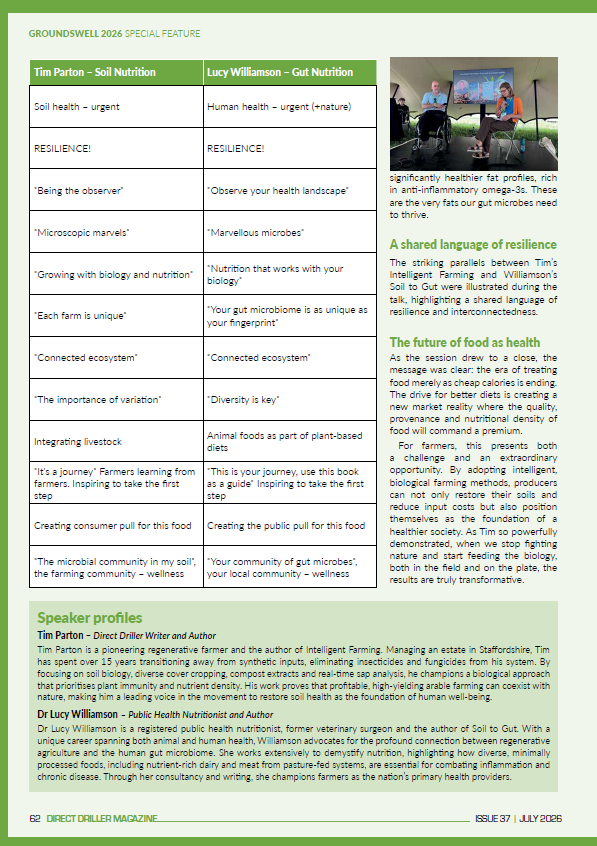
The striking parallels between Tim’s Intelligent Farming and Williamson’s Soil to Gut were illustrated during the talk, highlighting a shared language of resilience and interconnectedness.
The future of food as health
As the session drew to a close, the message was clear: the era of treating food merely as cheap calories is ending. The drive for better diets is creating a new market reality where the quality, provenance and nutritional density of food will command a premium.
For farmers, this presents both a challenge and an extraordinary opportunity. By adopting intelligent, biological farming methods, producers can not only restore their soils and reduce input costs but also position themselves as the foundation of a healthier society. As Tim so powerfully demonstrated, when we stop fighting nature and start feeding the biology, both in the field and on the plate, the results are truly transformative.
Speaker profiles
Tim Parton – Direct Driller Writer and Author
Tim Parton is a pioneering regenerative farmer and the author of Intelligent Farming. Managing an estate in Staffordshire, Tim has spent over 15 years transitioning away from synthetic inputs, eliminating insecticides and fungicides from his system. By focusing on soil biology, diverse cover cropping, compost extracts and real-time sap analysis, he champions a biological approach that prioritises plant immunity and nutrient density. His work proves that profitable, high-yielding arable farming can coexist with nature, making him a leading voice in the movement to restore soil health as the foundation of human well-being.
Dr Lucy Williamson – Public Health Nutritionist and Author
Dr Lucy Williamson is a registered public health nutritionist, former veterinary surgeon and the author of Soil to Gut. With a unique career spanning both animal and human health, Williamson advocates for the profound connection between regenerative agriculture and the human gut microbiome. She works extensively to demystify nutrition, highlighting how diverse, minimally processed foods, including nutrient-rich dairy and meat from pasture-fed systems, are essential for combating inflammation and chronic disease. Through her consultancy and writing, she champions farmers as the nation’s primary health providers.