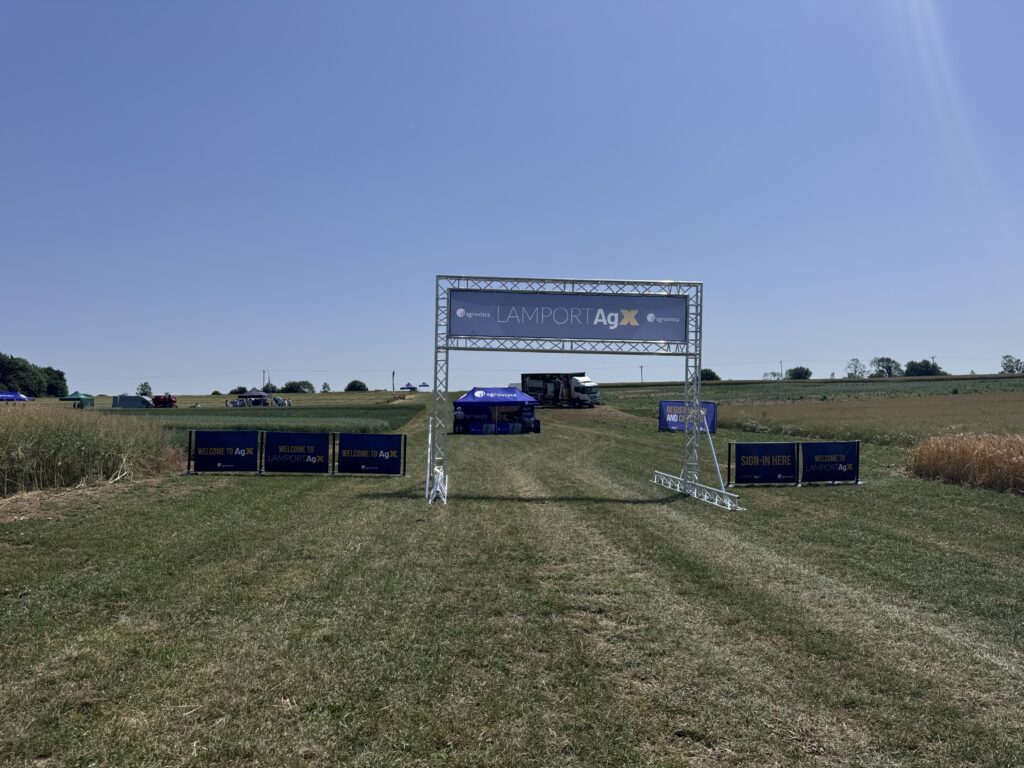
If the recent Limagrain demonstration day in Staffordshire highlighted a growing frustration with the rigid confines of the Recommended List (RL), Agrovista’s Lamport AgX open day in Northamptonshire provided a masterclass in what happens when you step outside them.
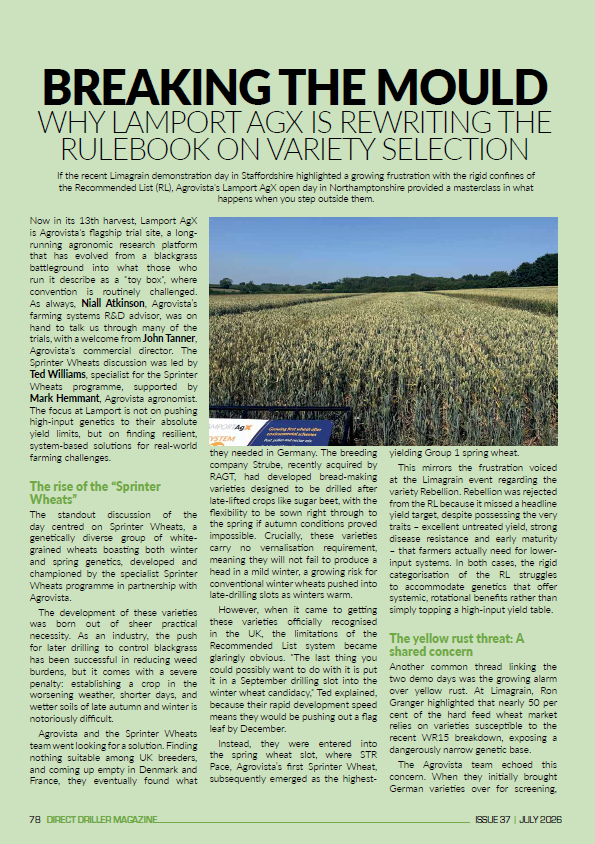
Now in its 13th harvest, Lamport AgX is Agrovista’s flagship trial site, a long-running agronomic research platform that has evolved from a blackgrass battleground into what those who run it describe as a “toy box”, where convention is routinely challenged.
As always, Niall Atkinson, Agrovista’s farming systems R&D advisor, was on hand to talk us through many of the trials, with a welcome from John Tanner, Agrovista’s commercial director. The Sprinter Wheats discussion was led by Ted Williams, specialist for the Sprinter Wheats programme, supported by Mark Hemmant, Agrovista agronomist. The focus at Lamport is not on pushing high-input genetics to their absolute yield limits, but on finding resilient, system-based solutions for real-world farming challenges.
The rise of the “Sprinter Wheats”
The standout discussion of the day centred on Sprinter Wheats, a genetically diverse group of white-grained wheats boasting both winter and spring genetics, developed and championed by the specialist Sprinter Wheats programme in partnership with Agrovista.
The development of these varieties was born out of sheer practical necessity. As an industry, the push for later drilling to control blackgrass has been successful in reducing weed burdens, but it comes with a severe penalty: establishing a crop in the worsening weather, shorter days, and wetter soils of late autumn and winter is notoriously difficult.
Agrovista and the Sprinter Wheats team went looking for a solution. Finding nothing suitable among UK breeders, and coming up empty in Denmark and France, they eventually found what they needed in Germany. The breeding company Strube, recently acquired by RAGT, had developed bread-making varieties designed to be drilled after late-lifted crops like sugar beet, with the flexibility to be sown right through to the spring if autumn conditions proved impossible. Crucially, these varieties carry no vernalisation requirement, meaning they will not fail to produce a head in a mild winter, a growing risk for conventional winter wheats pushed into late-drilling slots as winters warm.
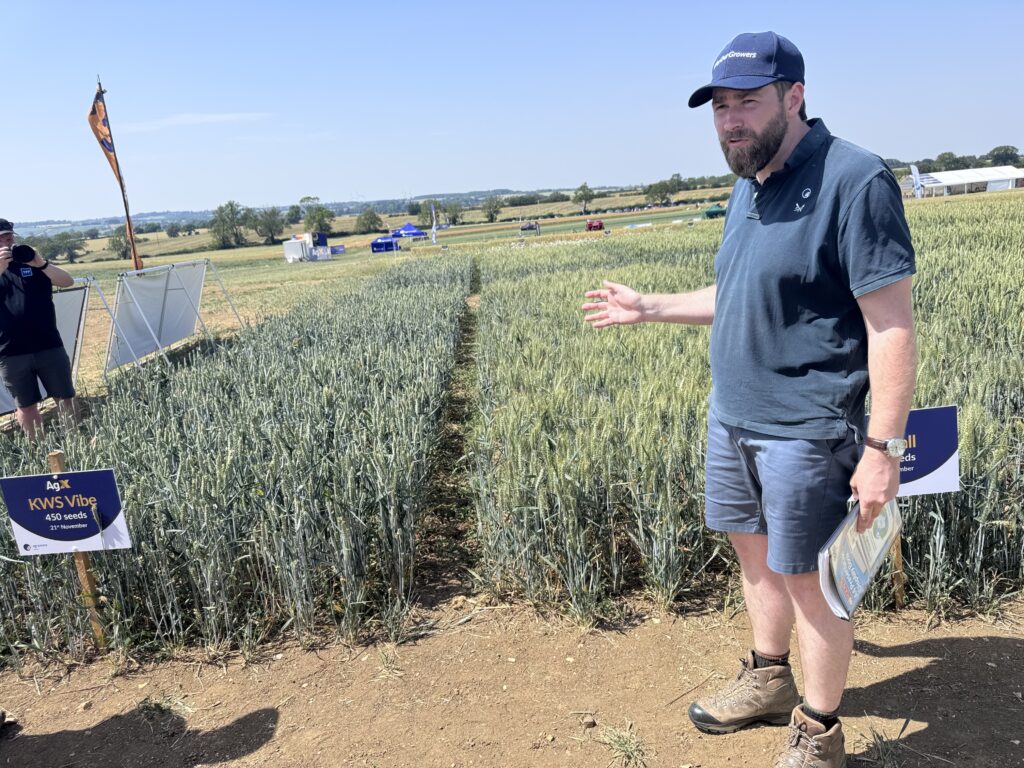
However, when it came to getting these varieties officially recognised in the UK, the limitations of the Recommended List system became glaringly obvious. “The last thing you could possibly want to do with it is put it in a September drilling slot into the winter wheat candidacy,” Ted explained, because their rapid development speed means they would be pushing out a flag leaf by December.
Instead, they were entered into the spring wheat slot, where STR Pace, Agrovista’s first Sprinter Wheat, subsequently emerged as the highest-yielding Group 1 spring wheat.
This mirrors the frustration voiced at the Limagrain event regarding the variety Rebellion. Rebellion was rejected from the RL because it missed a headline yield target, despite possessing the very traits – excellent untreated yield, strong disease resistance and early maturity – that farmers actually need for lower-input systems. In both cases, the rigid categorisation of the RL struggles to accommodate genetics that offer systemic, rotational benefits rather than simply topping a high-input yield table.
The yellow rust threat: A shared concern
Another common thread linking the two demo days was the growing alarm over yellow rust. At Limagrain, Ron Granger highlighted that nearly 50 per cent of the hard feed wheat market relies on varieties susceptible to the recent WR15 breakdown, exposing a dangerously narrow genetic base.
The Agrovista team echoed this concern. When they initially brought German varieties over for screening, they found them highly susceptible to UK strains of yellow rust, a reminder that different countries carry different pathogen populations, and that importing genetics is not a simple shortcut. It took further screening of different genetic mixtures to find robust varieties. The message from both events is clear: the UK needs broader genetic diversity to combat evolving disease threats, and the current RL system may not be moving fast enough to provide it.
Thirteen years of evidence: What the Lamport systems show
One of the most compelling arguments made at Lamport was not about a new variety or a new product, it was about time. Systems 3 and 4 at the site have now been growing spring wheat continuously for 13 harvests, using cover crops and direct drilling as the primary tools for grassweed management. The early sceptics who predicted that blackgrass would simply adapt to become a spring germinator have been proved wrong. “We are not getting any grass weed return even after 13 years,” Niall confirmed. “And we’re getting all the soil health benefits from those cover crops.”
The subtle but important difference between the two plots illustrates how far the thinking has evolved. System 3 involves a small amount of soil movement in the autumn ahead of the cover crop. System 4 has had no meaningful soil disturbance at all for years; the cover crop is always direct drilled. Agrovista agronomist Chris Martin recently conducted a slake test under the System 4 plots and found water infiltrating straight through the profile, matching the soil structure found under an undisturbed hedgerow. System 7, by contrast, where no cover crop has ever been grown, showed water puddling on the surface. The visual difference between the plots told its own story.
Italian ryegrass, however, is an emerging challenge. A strip of ryegrass was accidentally introduced to the site years ago by a contractor whose drill hygiene was not what it should have been. “It’s been getting worse and worse,” Niall acknowledged. The current approach is to put the affected strip down to a cutting mix of grass and legumes for two to three years, exhausting the Italian ryegrass seedbank rather than relying on chemistry. Even a visiting Australian study group, farmers who have access to a much wider range of herbicides than UK growers, had no better answer when they saw the plot.
Rethinking nutrition: The last 50 kilos
While the AHDB RL trials continue to test varieties under optimal, high-nitrogen regimes (sometimes exceeding 300kg/ha), the conversation at Lamport was firmly focused on efficiency and reduction.
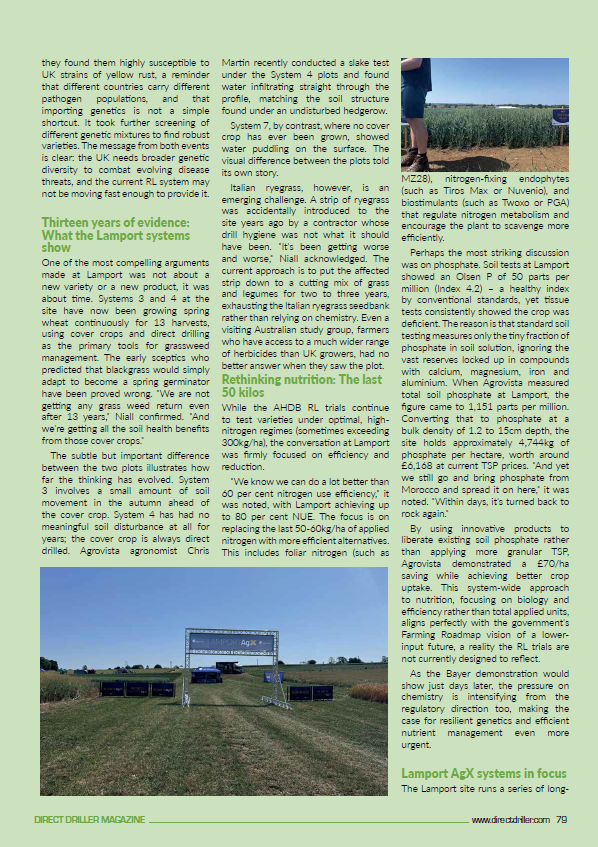
“We know we can do a lot better than 60 per cent nitrogen use efficiency,” it was noted, with Lamport achieving up to 80 per cent NUE. The focus is on replacing the last 50-60kg/ha of applied nitrogen with more efficient alternatives. This includes foliar nitrogen (such as MZ28), nitrogen-fixing endophytes (such as Tiros Max or Nuvenio), and biostimulants (such as Twoxo or PGA) that regulate nitrogen metabolism and encourage the plant to scavenge more efficiently.
Perhaps the most striking discussion was on phosphate. Soil tests at Lamport showed an Olsen P of 50 parts per million (Index 4.2) – a healthy index by conventional standards, yet tissue tests consistently showed the crop was deficient. The reason is that standard soil testing measures only the tiny fraction of phosphate in soil solution, ignoring the vast reserves locked up in compounds with calcium, magnesium, iron and aluminium. When Agrovista measured total soil phosphate at Lamport, the figure came to 1,151 parts per million. Converting that to phosphate at a bulk density of 1.2 to 15cm depth, the site holds approximately 4,744kg of phosphate per hectare, worth around £6,168 at current TSP prices. “And yet we still go and bring phosphate from Morocco and spread it on here,” it was noted. “Within days, it’s turned back to rock again.”
By using innovative products to liberate existing soil phosphate rather than applying more granular TSP, Agrovista demonstrated a £70/ha saving while achieving better crop uptake. This system-wide approach to nutrition, focusing on biology and efficiency rather than total applied units, aligns perfectly with the government’s Farming Roadmap vision of a lower-input future, a reality the RL trials are not currently designed to reflect.
As the Bayer demonstration would show just days later, the pressure on chemistry is intensifying from the regulatory direction too, making the case for resilient genetics and efficient nutrient management even more urgent.
Lamport AgX systems in focus
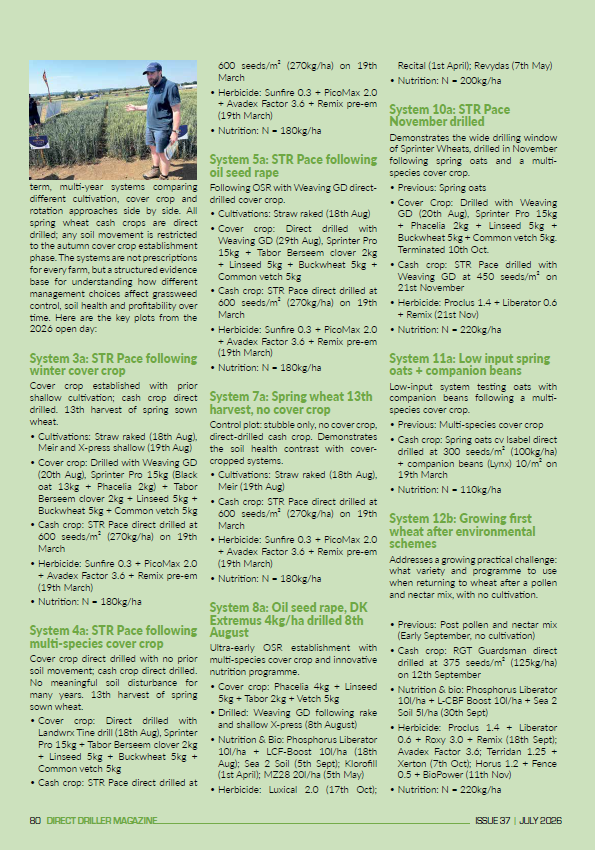
The Lamport site runs a series of long-term, multi-year systems comparing different cultivation, cover crop and rotation approaches side by side. All spring wheat cash crops are direct drilled; any soil movement is restricted to the autumn cover crop establishment phase. The systems are not prescriptions for every farm, but a structured evidence base for understanding how different management choices affect grassweed control, soil health and profitability over time. Here are the key plots from the 2026 open day:
System 3a: STR Pace following winter cover crop
Cover crop established with prior shallow cultivation; cash crop direct drilled. 13th harvest of spring sown wheat.
- Cultivations: Straw raked (18th Aug), Meir and X-press shallow (19th Aug)
- Cover crop: Drilled with Weaving GD (20th Aug), Sprinter Pro 15kg (Black oat 13kg + Phacelia 2kg) + Tabor Berseem clover 2kg + Linseed 5kg + Buckwheat 5kg + Common vetch 5kg
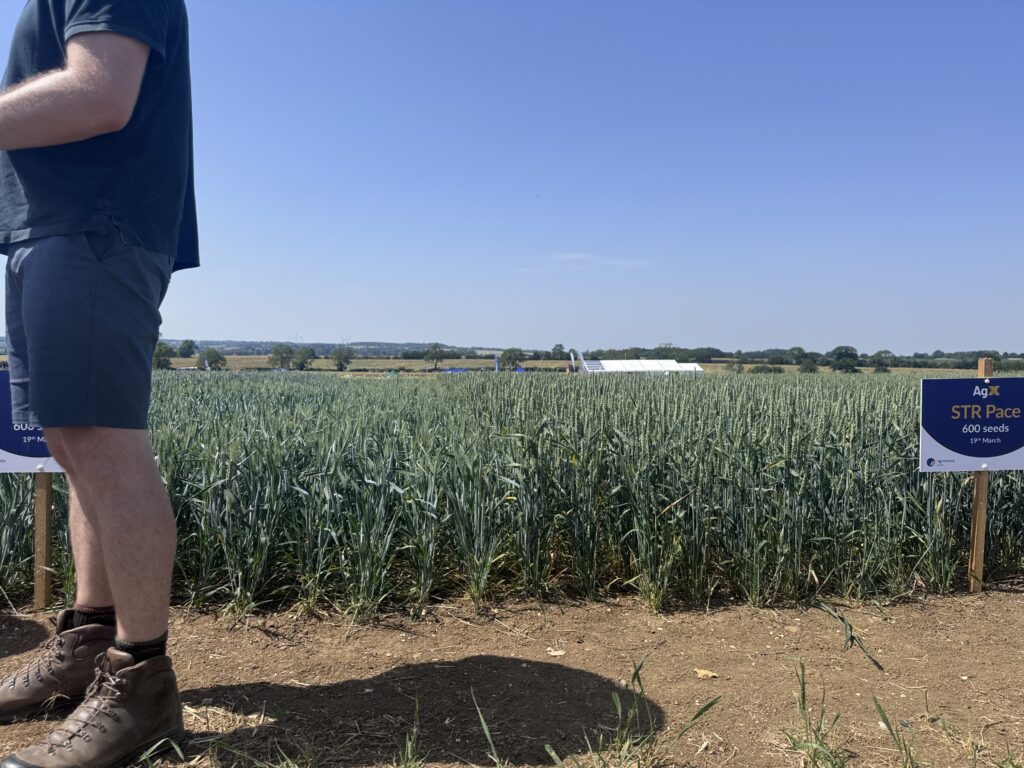
- Cash crop: STR Pace direct drilled at 600 seeds/m² (270kg/ha) on 19th March
- Herbicide: Sunfire 0.3 + PicoMax 2.0 + Avadex Factor 3.6 + Remix pre-em (19th March)
- Nutrition: N = 180kg/ha
System 4a: STR Pace following multi-species cover crop
Cover crop direct drilled with no prior soil movement; cash crop direct drilled. No meaningful soil disturbance for many years. 13th harvest of spring sown wheat.
- Cover crop: Direct drilled with Landwrx Tine drill (18th Aug), Sprinter Pro 15kg + Tabor Berseem clover 2kg + Linseed 5kg + Buckwheat 5kg + Common vetch 5kg
- Cash crop: STR Pace direct drilled at 600 seeds/m² (270kg/ha) on 19th March
- Herbicide: Sunfire 0.3 + PicoMax 2.0 + Avadex Factor 3.6 + Remix pre-em (19th March)
- Nutrition: N = 180kg/ha
System 5a: STR Pace following oil seed rape
Following OSR with Weaving GD direct-drilled cover crop.
- Cultivations: Straw raked (18th Aug)
- Cover crop: Direct drilled with Weaving GD (29th Aug), Sprinter Pro 15kg + Tabor Berseem clover 2kg + Linseed 5kg + Buckwheat 5kg + Common vetch 5kg
- Cash crop: STR Pace direct drilled at 600 seeds/m² (270kg/ha) on 19th March
- Herbicide: Sunfire 0.3 + PicoMax 2.0 + Avadex Factor 3.6 + Remix pre-em (19th March)
- Nutrition: N = 180kg/ha
System 7a: Spring wheat 13th harvest, no cover crop
Control plot: stubble only, no cover crop, direct-drilled cash crop. Demonstrates the soil health contrast with cover-cropped systems.
- Cultivations: Straw raked (18th Aug), Meir (19th Aug)
- Cash crop: STR Pace direct drilled at 600 seeds/m² (270kg/ha) on 19th March
- Herbicide: Sunfire 0.3 + PicoMax 2.0 + Avadex Factor 3.6 + Remix pre-em (19th March)
- Nutrition: N = 180kg/ha
System 8a: Oil seed rape, DK Extremus 4kg/ha drilled 8th August
Ultra-early OSR establishment with multi-species cover crop and innovative nutrition programme.
- Cover crop: Phacelia 4kg + Linseed 5kg + Tabor 2kg + Vetch 5kg
- Drilled: Weaving GD following rake and shallow X-press (8th August)
- Nutrition & Bio: Phosphorus Liberator 10l/ha + LCF-Boost 10l/ha (18th Aug); Sea 2 Soil (5th Sept); Klorofill (1st April); MZ28 20l/ha (5th May)
- Herbicide: Luxical 2.0 (17th Oct); Recital (1st April); Revydas (7th May)
- Nutrition: N = 200kg/ha
System 10a: STR Pace November drilled
Demonstrates the wide drilling window of Sprinter Wheats, drilled in November following spring oats and a multi-species cover crop.
- Previous: Spring oats
- Cover Crop: Drilled with Weaving GD (20th Aug), Sprinter Pro 15kg + Phacelia 2kg + Linseed 5kg + Buckwheat 5kg + Common vetch 5kg. Terminated 10th Oct.
- Cash crop: STR Pace drilled with Weaving GD at 450 seeds/m² on 21st November
- Herbicide: Proclus 1.4 + Liberator 0.6 + Remix (21st Nov)
- Nutrition: N = 220kg/ha
System 11a: Low input spring oats + companion beans
Low-input system testing oats with companion beans following a multi-species cover crop.
- Previous: Multi-species cover crop
- Cash crop: Spring oats cv Isabel direct drilled at 300 seeds/m² (100kg/ha) + companion beans (Lynx) 10/m² on 19th March
- Nutrition: N = 110kg/ha
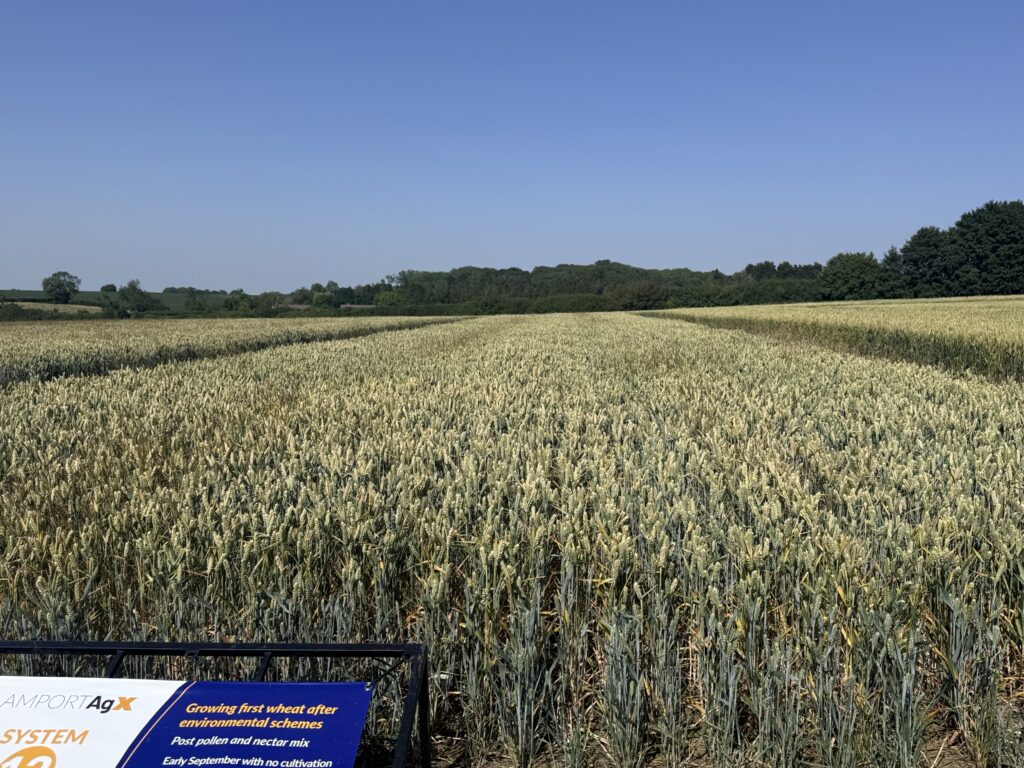
System 12b: Growing first wheat after environmental schemes
Addresses a growing practical challenge: what variety and programme to use when returning to wheat after a pollen and nectar mix, with no cultivation.
- Previous: Post pollen and nectar mix (Early September, no cultivation)
- Cash crop: RGT Guardsman direct drilled at 375 seeds/m² (125kg/ha) on 12th September
- Nutrition & bio: Phosphorus Liberator 10l/ha + L-CBF Boost 10l/ha + Sea 2 Soil 5l/ha (30th Sept)
- Herbicide: Proclus 1.4 + Liberator 0.6 + Roxy 3.0 + Remix (18th Sept); Avadex Factor 3.6; Terridan 1.25 + Xerton (7th Oct); Horus 1.2 + Fence 0.5 + BioPower (11th Nov)
- Nutrition: N = 220kg/ha