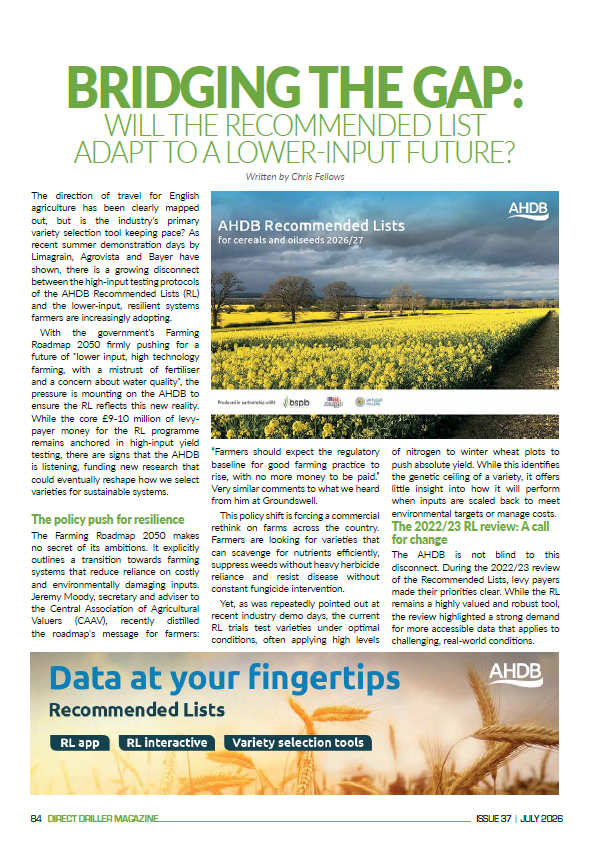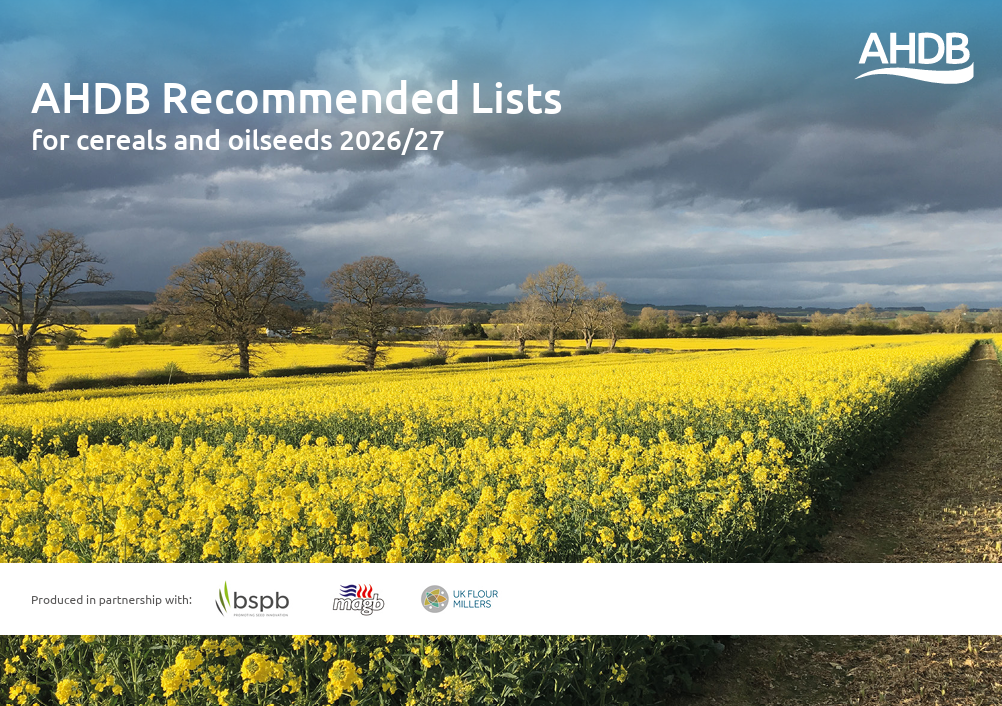
The direction of travel for English agriculture has been clearly mapped out, but is the industry’s primary variety selection tool keeping pace? As recent summer demonstration days by Limagrain, Agrovista and Bayer have shown, there is a growing disconnect between the high-input testing protocols of the AHDB Recommended Lists (RL) and the lower-input, resilient systems farmers are increasingly adopting.
With the government’s Farming Roadmap 2050 firmly pushing for a future of “lower input, high technology farming, with a mistrust of fertiliser and a concern about water quality”, the pressure is mounting on the AHDB to ensure the RL reflects this new reality. While the core £9-10 million of levy-payer money for the RL programme remains anchored in high-input yield testing, there are signs that the AHDB is listening, funding new research that could eventually reshape how we select varieties for sustainable systems.
The policy push for resilience
The Farming Roadmap 2050 makes no secret of its ambitions. It explicitly outlines a transition towards farming systems that reduce reliance on costly and environmentally damaging inputs. Jeremy Moody, secretary and adviser to the Central Association of Agricultural Valuers (CAAV), recently distilled the roadmap’s message for farmers: “Farmers should expect the regulatory baseline for good farming practice to rise, with no more money to be paid.” Very similar comments to what we heard from him at Groundswell.
This policy shift is forcing a commercial rethink on farms across the country. Farmers are looking for varieties that can scavenge for nutrients efficiently, suppress weeds without heavy herbicide reliance and resist disease without constant fungicide intervention.
Yet, as was repeatedly pointed out at recent industry demo days, the current RL trials test varieties under optimal conditions, often applying high levels of nitrogen to winter wheat plots to push absolute yield. While this identifies the genetic ceiling of a variety, it offers little insight into how it will perform when inputs are scaled back to meet environmental targets or manage costs.
The 2022/23 RL review: A call for change
The AHDB is not blind to this disconnect. During the 2022/23 review of the Recommended Lists, levy payers made their priorities clear. While the RL remains a highly valued and robust tool, the review highlighted a strong demand for more accessible data that applies to challenging, real-world conditions.
Growers explicitly asked for information relevant to new establishment techniques like direct drilling, and for data on how varieties perform on variable or “lighter” land. The steering committee acknowledged that traditional small-plot replicated trials struggle to accurately test these newer, lower-disturbance techniques. Furthermore, data from highly variable land is often excluded from the main RL dataset because it lacks statistical robustness, despite being highly practical information for farmers working those specific soils.
The review also identified a significant appetite for crop physiology information, particularly to assist with variety selection under lower inputs and to improve competitiveness against grassweeds.

Testing traits for a low-input future
While a complete overhaul of the RL programme takes time, the AHDB is taking steps to address these demands through targeted research. A prime example is a new £59,000 project led by ADAS, COPE and the Organic Research Centre (ORC), which is assessing crop physiology traits for their competitiveness against weeds in low-input and organic systems.
This project builds on a decade of research, expanding from a small network of “Magnificent Seven” farmers to 16 farms across England conducting large-scale commercial strip trials alongside standard AHDB plot trials. The research moves beyond simply looking at yield, focusing instead on three key physiological traits that give a variety the edge over weeds:
- Early ground cover: Rapid canopy development to smother weeds early in the season.
- Early vigour: Fast establishment and growth to out-compete weeds for light and resources.
- Late height: A taller canopy structure later in the season to suppress later-emerging weeds.
The results so far are compelling. Data suggests a 33 per cent yield increase in modern, weed-suppressive varieties compared to earlier commercial choices. In organic systems, the yield variation between top and bottom performing varieties can be around 1.8 t/ha – nearly a 50 per cent difference for a typical organic farm yielding 4 t/ha.
Blends and resilience
The low-input research project is also validating a concept that was hotly debated at the recent Limagrain and Bayer demo days: variety blends.
The research shows that blends often outperform their component varieties, offering potential benefits from genetic diversity and complementary traits. For example, combining an early-developing variety with a late-developing one allows them to utilise resources without competing against each other, enhancing overall climate resilience. “A combination like Extase and Goldfinch would be an excellent example,” notes Dominic Amos of COPE.
This aligns with the advice from breeders at the summer demo days, who advocated for blending clean, disease-resistant varieties to protect genetics and slow the spread of pathogens like yellow rust, rather than using blends to hide susceptible varieties.
Will the data reach the RL?
The crucial question is how this new, highly relevant data will be delivered to farmers. Henny Lowth, AHDB project coordinator for the weed-suppression trials, has stated that all data reports will be open access, adding: “If the RL is a suitable place for the data, we will include it.”
This encapsulates the current challenge for the AHDB. As the industry moves towards the government’s vision of a lower-input, highly resilient farming sector, the definition of a “good” variety is changing. It is no longer just about peak treated yield; it is about early vigour, weed suppression, nutrient use efficiency and untreated disease resistance.
The AHDB has the mandate from the 2022 review, and it is beginning to generate the necessary data through projects like the low-input wheat trials. The next, and perhaps most difficult, step will be integrating these diverse, systemic traits into the core Recommended List, ensuring it remains the definitive guide for a changing agricultural landscape.