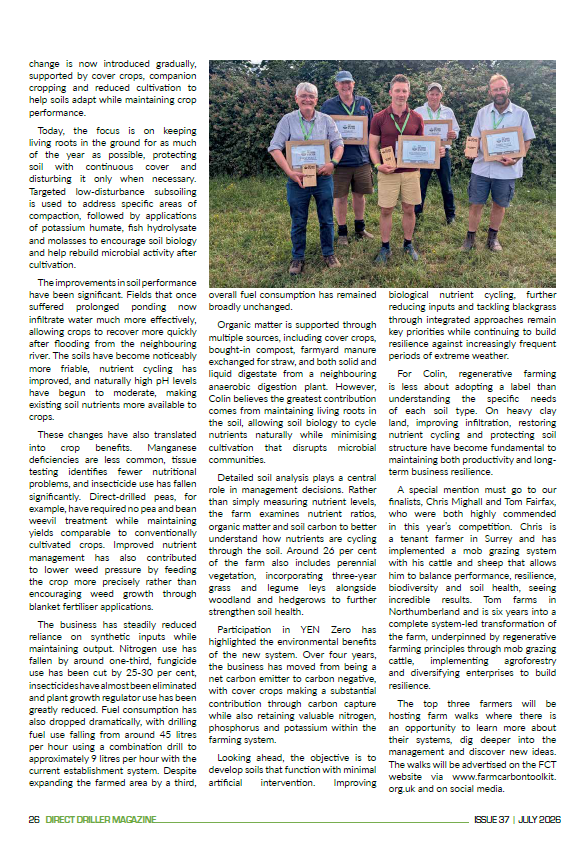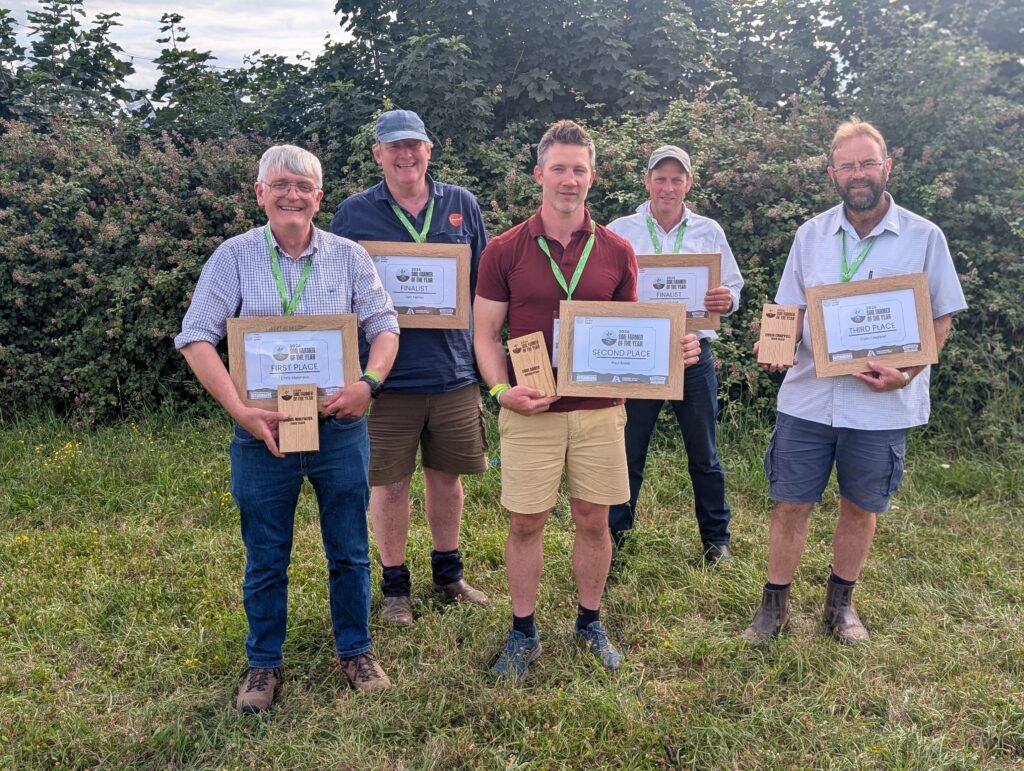
The Soil Farmer of the Year competition has been running for the last 10 years and aims to find, promote and champion those farmers who are putting soil health at the centre of their farm business. Over the last ten years, we have found and rewarded farmers from all across the UK who are running a range of farming systems and who have one thing in common: a drive to prioritise their most important asset on-farm – their soil. The competition is organised by Farm Carbon Toolkit and Innovation for Agriculture and kindly sponsored by Cotswold Seeds and Hutchinsons.
This year, we received over 20 applications from a diverse assortment of farmers, who were whittled down to eight for online interviews. Following these online interviews, five farmers were selected for in-person visits to understand more about their farming system and dig deeper into their soils. From these visits, the judges were able to decide on the winning farmers, who were awarded their prizes at a session at Groundswell. Farmers attending the ceremony heard directly from the winners about the practical changes they have made to improve soil health and the impact those changes have had on their business.
All three of our winning farmers were able to demonstrate during the session how better soil management had strengthened their farm business through improved profitability and enhanced resilience to increasingly challenging weather conditions.
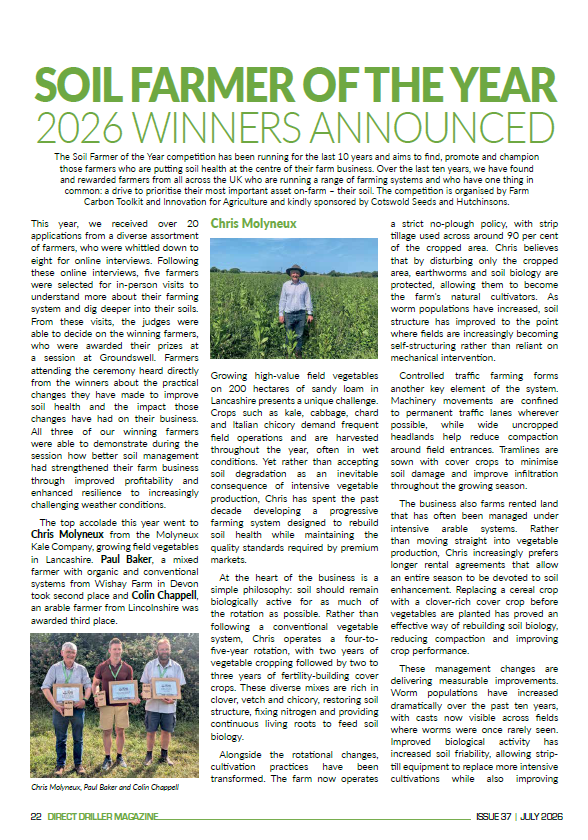
The top accolade this year went to Chris Molyneux from the Molyneux Kale Company, growing field vegetables in Lancashire. Paul Baker, a mixed farmer with organic and conventional systems from Wishay Farm in Devon took second place and Colin Chappell, an arable farmer from Lincolnshire was awarded third place.
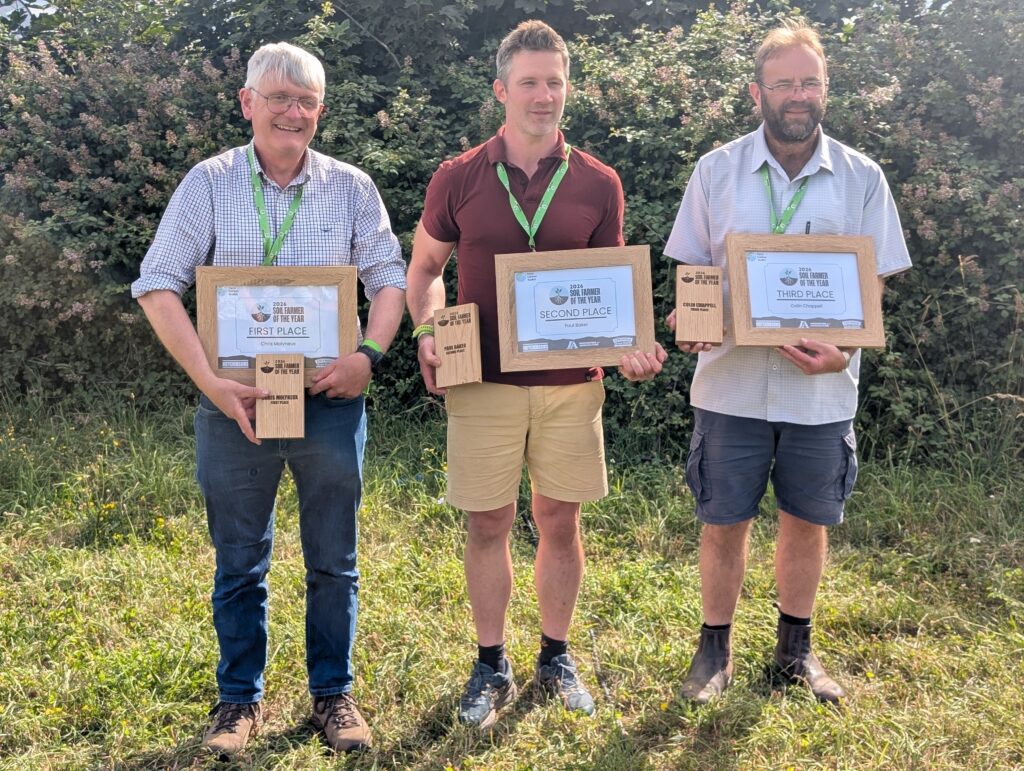
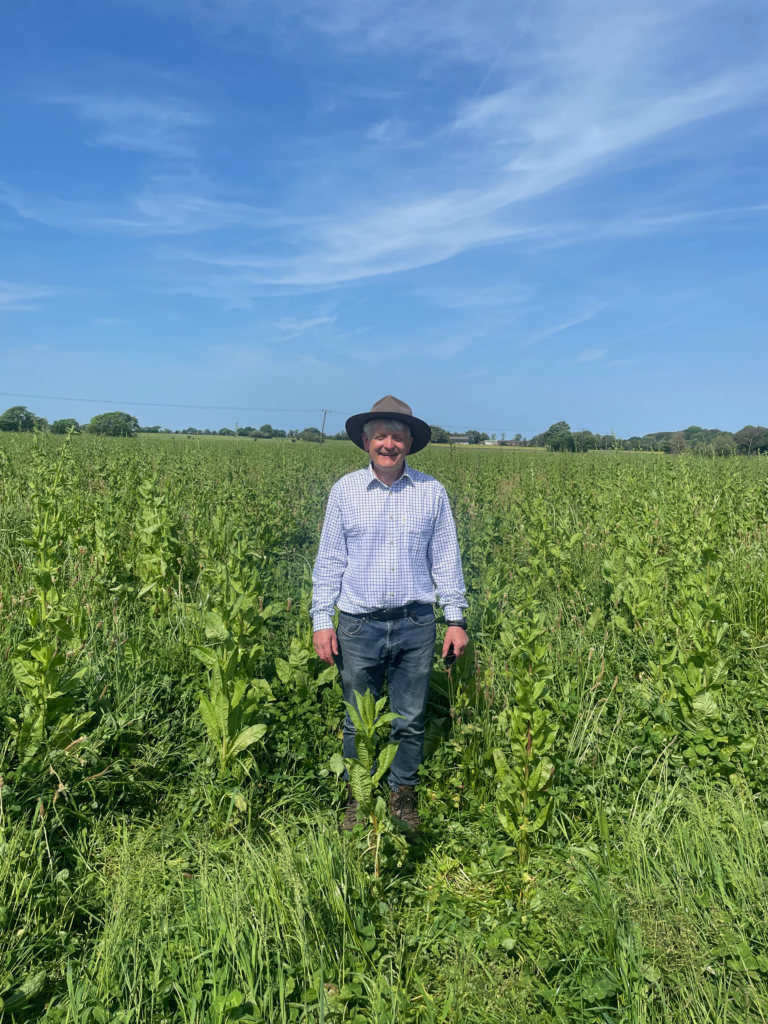
Chris Molyneux
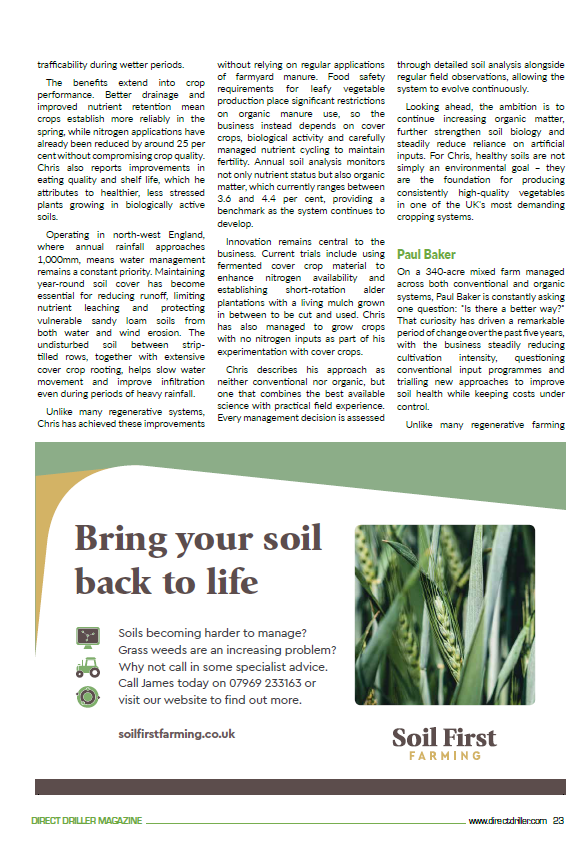
Growing high-value field vegetables on 200 hectares of sandy loam in Lancashire presents a unique challenge. Crops such as kale, cabbage, chard and Italian chicory demand frequent field operations and are harvested throughout the year, often in wet conditions. Yet rather than accepting soil degradation as an inevitable consequence of intensive vegetable production, Chris has spent the past decade developing a progressive farming system designed to rebuild soil health while maintaining the quality standards required by premium markets.
At the heart of the business is a simple philosophy: soil should remain biologically active for as much of the rotation as possible. Rather than following a conventional vegetable system, Chris operates a four-to-five-year rotation, with two years of vegetable cropping followed by two to three years of fertility-building cover crops. These diverse mixes are rich in clover, vetch and chicory, restoring soil structure, fixing nitrogen and providing continuous living roots to feed soil biology.
Alongside the rotational changes, cultivation practices have been transformed. The farm now operates a strict no-plough policy, with strip tillage used across around 90 per cent of the cropped area. Chris believes that by disturbing only the cropped area, earthworms and soil biology are protected, allowing them to become the farm’s natural cultivators. As worm populations have increased, soil structure has improved to the point where fields are increasingly becoming self-structuring rather than reliant on mechanical intervention.
Controlled traffic farming forms another key element of the system. Machinery movements are confined to permanent traffic lanes wherever possible, while wide uncropped headlands help reduce compaction around field entrances. Tramlines are sown with cover crops to minimise soil damage and improve infiltration throughout the growing season.
The business also farms rented land that has often been managed under intensive arable systems. Rather than moving straight into vegetable production, Chris increasingly prefers longer rental agreements that allow an entire season to be devoted to soil enhancement. Replacing a cereal crop with a clover-rich cover crop before vegetables are planted has proved an effective way of rebuilding soil biology, reducing compaction and improving crop performance.
These management changes are delivering measurable improvements. Worm populations have increased dramatically over the past ten years, with casts now visible across fields where worms were once rarely seen. Improved biological activity has increased soil friability, allowing strip-till equipment to replace more intensive cultivations while also improving trafficability during wetter periods.
The benefits extend into crop performance. Better drainage and improved nutrient retention mean crops establish more reliably in the spring, while nitrogen applications have already been reduced by around 25 per cent without compromising crop quality. Chris also reports improvements in eating quality and shelf life, which he attributes to healthier, less stressed plants growing in biologically active soils.
Operating in north-west England, where annual rainfall approaches 1,000mm, means water management remains a constant priority. Maintaining year-round soil cover has become essential for reducing runoff, limiting nutrient leaching and protecting vulnerable sandy loam soils from both water and wind erosion. The undisturbed soil between strip-tilled rows, together with extensive cover crop rooting, helps slow water movement and improve infiltration even during periods of heavy rainfall.
Unlike many regenerative systems, Chris has achieved these improvements without relying on regular applications of farmyard manure. Food safety requirements for leafy vegetable production place significant restrictions on organic manure use, so the business instead depends on cover crops, biological activity and carefully managed nutrient cycling to maintain fertility. Annual soil analysis monitors not only nutrient status but also organic matter, which currently ranges between 3.6 and 4.4 per cent, providing a benchmark as the system continues to develop.
Innovation remains central to the business. Current trials include using fermented cover crop material to enhance nitrogen availability and establishing short-rotation alder plantations with a living mulch grown in between to be cut and used. Chris has also managed to grow crops with no nitrogen inputs as part of his experimentation with cover crops.
Chris describes his approach as neither conventional nor organic, but one that combines the best available science with practical field experience. Every management decision is assessed through detailed soil analysis alongside regular field observations, allowing the system to evolve continuously.
Looking ahead, the ambition is to continue increasing organic matter, further strengthen soil biology and steadily reduce reliance on artificial inputs. For Chris, healthy soils are not simply an environmental goal – they are the foundation for producing consistently high-quality vegetables in one of the UK’s most demanding cropping systems.
Paul Baker
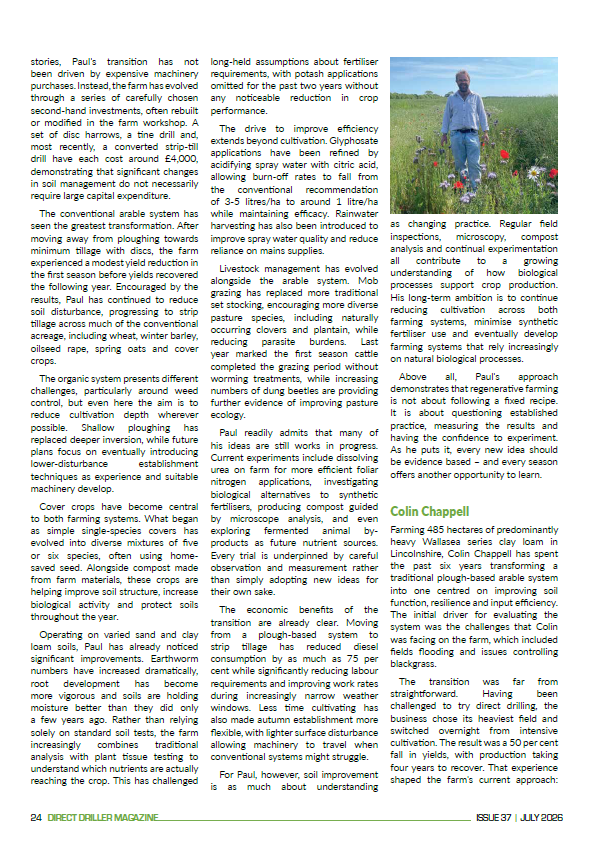
On a 340-acre mixed farm managed across both conventional and organic systems, Paul Baker is constantly asking one question: “Is there a better way?” That curiosity has driven a remarkable period of change over the past five years, with the business steadily reducing cultivation intensity, questioning conventional input programmes and trialling new approaches to improve soil health while keeping costs under control.
Unlike many regenerative farming stories, Paul’s transition has not been driven by expensive machinery purchases. Instead, the farm has evolved through a series of carefully chosen second-hand investments, often rebuilt or modified in the farm workshop. A set of disc harrows, a tine drill and, most recently, a converted strip-till drill have each cost around £4,000, demonstrating that significant changes in soil management do not necessarily require large capital expenditure.
The conventional arable system has seen the greatest transformation. After moving away from ploughing towards minimum tillage with discs, the farm experienced a modest yield reduction in the first season before yields recovered the following year. Encouraged by the results, Paul has continued to reduce soil disturbance, progressing to strip tillage across much of the conventional acreage, including wheat, winter barley, oilseed rape, spring oats and cover crops.
The organic system presents different challenges, particularly around weed control, but even here the aim is to reduce cultivation depth wherever possible. Shallow ploughing has replaced deeper inversion, while future plans focus on eventually introducing lower-disturbance establishment techniques as experience and suitable machinery develop.
Cover crops have become central to both farming systems. What began as simple single-species covers has evolved into diverse mixtures of five or six species, often using home-saved seed. Alongside compost made from farm materials, these crops are helping improve soil structure, increase biological activity and protect soils throughout the year.
Operating on varied sand and clay loam soils, Paul has already noticed significant improvements. Earthworm numbers have increased dramatically, root development has become more vigorous and soils are holding moisture better than they did only a few years ago. Rather than relying solely on standard soil tests, the farm increasingly combines traditional analysis with plant tissue testing to understand which nutrients are actually reaching the crop. This has challenged long-held assumptions about fertiliser requirements, with potash applications omitted for the past two years without any noticeable reduction in crop performance.
The drive to improve efficiency extends beyond cultivation. Glyphosate applications have been refined by acidifying spray water with citric acid, allowing burn-off rates to fall from the conventional recommendation of 3-5 litres/ha to around 1 litre/ha while maintaining efficacy. Rainwater harvesting has also been introduced to improve spray water quality and reduce reliance on mains supplies.
Livestock management has evolved alongside the arable system. Mob grazing has replaced more traditional set stocking, encouraging more diverse pasture species, including naturally occurring clovers and plantain, while reducing parasite burdens. Last year marked the first season cattle completed the grazing period without worming treatments, while increasing numbers of dung beetles are providing further evidence of improving pasture ecology.
Paul readily admits that many of his ideas are still works in progress. Current experiments include dissolving urea on farm for more efficient foliar nitrogen applications, investigating biological alternatives to synthetic fertilisers, producing compost guided by microscope analysis, and even exploring fermented animal by-products as future nutrient sources. Every trial is underpinned by careful observation and measurement rather than simply adopting new ideas for their own sake.
The economic benefits of the transition are already clear. Moving from a plough-based system to strip tillage has reduced diesel consumption by as much as 75 per cent while significantly reducing labour requirements and improving work rates during increasingly narrow weather windows. Less time cultivating has also made autumn establishment more flexible, with lighter surface disturbance allowing machinery to travel when conventional systems might struggle.
For Paul, however, soil improvement is as much about understanding as changing practice. Regular field inspections, microscopy, compost analysis and continual experimentation all contribute to a growing understanding of how biological processes support crop production. His long-term ambition is to continue reducing cultivation across both farming systems, minimise synthetic fertiliser use and eventually develop farming systems that rely increasingly on natural biological processes.
Above all, Paul’s approach demonstrates that regenerative farming is not about following a fixed recipe. It is about questioning established practice, measuring the results and having the confidence to experiment. As he puts it, every new idea should be evidence based – and every season offers another opportunity to learn.
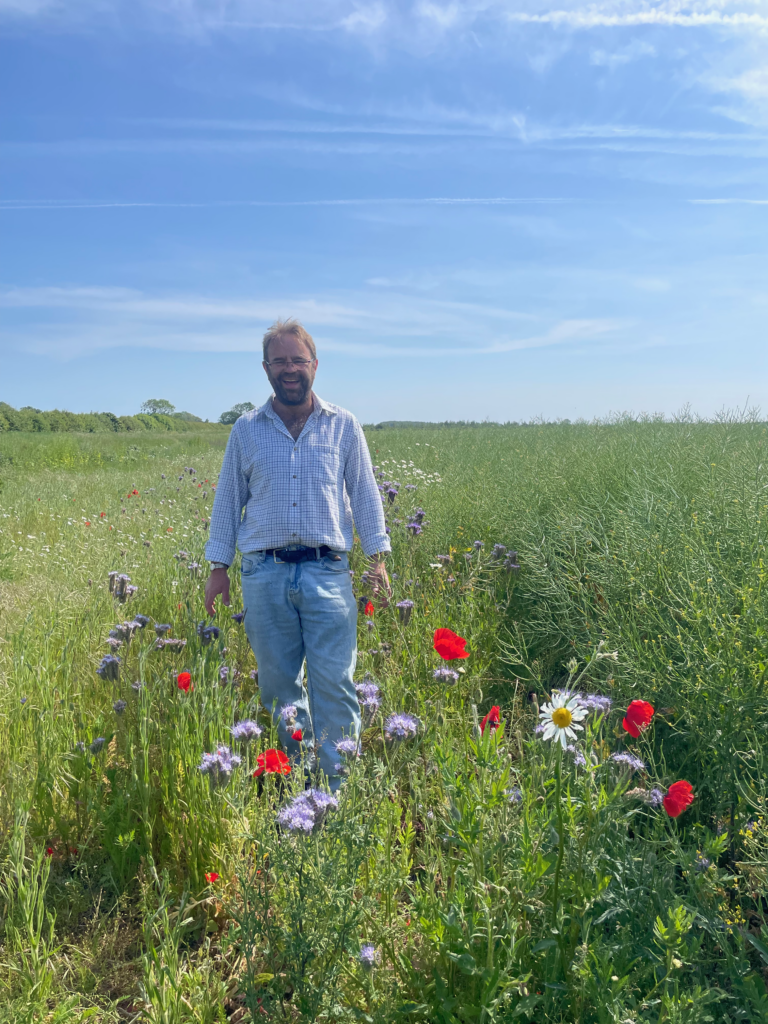
Colin Chappell
Farming 485 hectares of predominantly heavy Wallasea series clay loam in Lincolnshire, Colin Chappell has spent the past six years transforming a traditional plough-based arable system into one centred on improving soil function, resilience and input efficiency. The initial driver for evaluating the system was the challenges that Colin was facing on the farm, which included fields flooding and issues controlling blackgrass.
The transition was far from straightforward. Having been challenged to try direct drilling, the business chose its heaviest field and switched overnight from intensive cultivation. The result was a 50 per cent fall in yields, with production taking four years to recover. That experience shaped the farm’s current approach: change is now introduced gradually, supported by cover crops, companion cropping and reduced cultivation to help soils adapt while maintaining crop performance.
Today, the focus is on keeping living roots in the ground for as much of the year as possible, protecting soil with continuous cover and disturbing it only when necessary. Targeted low-disturbance subsoiling is used to address specific areas of compaction, followed by applications of potassium humate, fish hydrolysate and molasses to encourage soil biology and help rebuild microbial activity after cultivation.
The improvements in soil performance have been significant. Fields that once suffered prolonged ponding now infiltrate water much more effectively, allowing crops to recover more quickly after flooding from the neighbouring river. The soils have become noticeably more friable, nutrient cycling has improved, and naturally high pH levels have begun to moderate, making existing soil nutrients more available to crops.
These changes have also translated into crop benefits. Manganese deficiencies are less common, tissue testing identifies fewer nutritional problems, and insecticide use has fallen significantly. Direct-drilled peas, for example, have required no pea and bean weevil treatment while maintaining yields comparable to conventionally cultivated crops. Improved nutrient management has also contributed to lower weed pressure by feeding the crop more precisely rather than encouraging weed growth through blanket fertiliser applications.
The business has steadily reduced reliance on synthetic inputs while maintaining output. Nitrogen use has fallen by around one-third, fungicide use has been cut by 25-30 per cent, insecticides have almost been eliminated and plant growth regulator use has been greatly reduced. Fuel consumption has also dropped dramatically, with drilling fuel use falling from around 45 litres per hour using a combination drill to approximately 9 litres per hour with the current establishment system. Despite expanding the farmed area by a third, overall fuel consumption has remained broadly unchanged.
Organic matter is supported through multiple sources, including cover crops, bought-in compost, farmyard manure exchanged for straw, and both solid and liquid digestate from a neighbouring anaerobic digestion plant. However, Colin believes the greatest contribution comes from maintaining living roots in the soil, allowing soil biology to cycle nutrients naturally while minimising cultivation that disrupts microbial communities.
Detailed soil analysis plays a central role in management decisions. Rather than simply measuring nutrient levels, the farm examines nutrient ratios, organic matter and soil carbon to better understand how nutrients are cycling through the soil. Around 26 per cent of the farm also includes perennial vegetation, incorporating three-year grass and legume leys alongside woodland and hedgerows to further strengthen soil health.
Participation in YEN Zero has highlighted the environmental benefits of the new system. Over four years, the business has moved from being a net carbon emitter to carbon negative, with cover crops making a substantial contribution through carbon capture while also retaining valuable nitrogen, phosphorus and potassium within the farming system.
Looking ahead, the objective is to develop soils that function with minimal artificial intervention. Improving biological nutrient cycling, further reducing inputs and tackling blackgrass through integrated approaches remain key priorities while continuing to build resilience against increasingly frequent periods of extreme weather.
For Colin, regenerative farming is less about adopting a label than understanding the specific needs of each soil type. On heavy clay land, improving infiltration, restoring nutrient cycling and protecting soil structure have become fundamental to maintaining both productivity and long-term business resilience.
A special mention must go to our finalists, Chris Mighall and Tom Fairfax, who were both highly commended in this year’s competition. Chris is a tenant farmer in Surrey and has implemented a mob grazing system with his cattle and sheep that allows him to balance performance, resilience, biodiversity and soil health, seeing incredible results. Tom farms in Northumberland and is six years into a complete system-led transformation of the farm, underpinned by regenerative farming principles through mob grazing cattle, implementing agroforestry and diversifying enterprises to build resilience.
The top three farmers will be hosting farm walks where there is an opportunity to learn more about their systems, dig deeper into the management and discover new ideas. The walks will be advertised on the FCT website via www.farmcarbontoolkit.org.uk and on social media.