“We’re gonna groove on something else instead. We’re gonna groove on biodiversity and bread.”
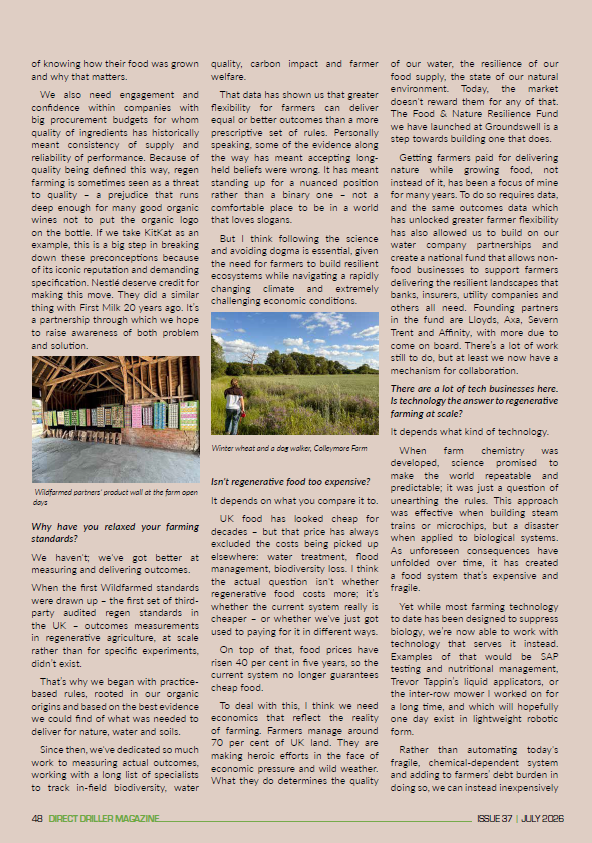
So said Grandma Funk, voice of our 1997 Groove Armada tune, I See You Baby, who you can hear on the video unexpectedly coming out of retirement during my DJ set for Groundswell’s 10th birthday.
Groundswell, the latest documentary from the makers of Kiss the Ground, launched the same week, and across the expanding festival site at the Cherry family farm, regen had the energy, in Victor Hugo’s words, of “an idea whose time has come.”
Yet despite solar now being cheaper than fossil fuels and biological farming systems more efficient than chemical ones, this doesn’t mean either transition will happen quickly enough. There are cultural and practical barriers, taxes still subsidising the status quo, true cost accounting still an idea rather than reality. Many problems need solving to make regen mainstream.

Above all, we need action. Farming in a festival environment took me back to the early, free party days of dance music – a reminder of the realities of the journey from niche to mainstream. House music went from illegal raves to a worldwide soundtrack. This didn’t happen by waiting for radio stations to start playing it; radio stations began playing it because House music lovers had shown up and created a movement.
While there’s still so much to be done before regen follows a house music trajectory, reflecting on Groundswell gave an opportunity to take stock of progress.
Wildfarmed’s Groundswell news included:
Research
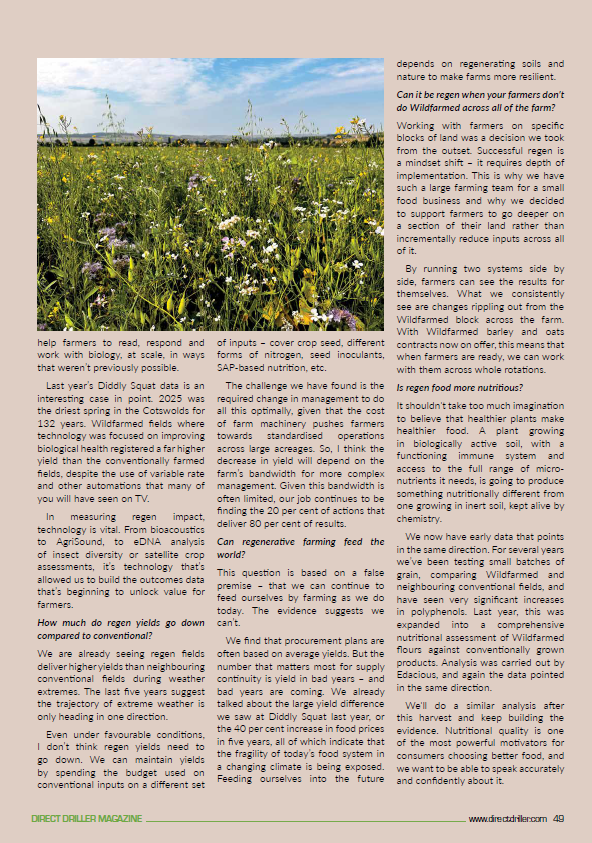
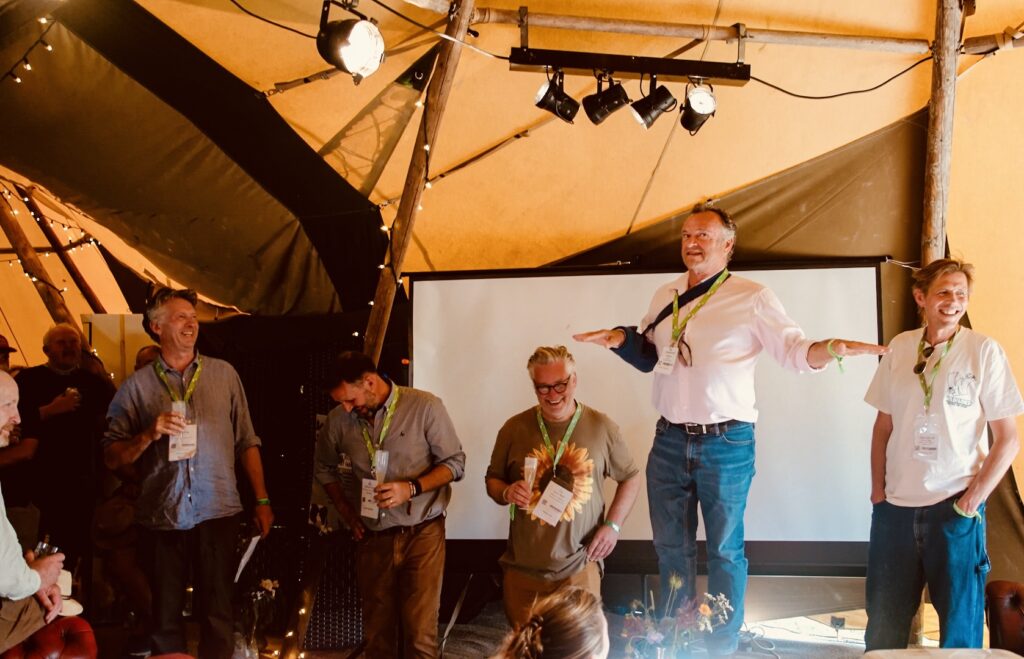
A year previously, Professor Andy Neal and I sheltered in a strip of shade behind the Wildfarmed stand to work out how he could dedicate himself to farmer-focused research. This year, the idea became reality with the launch of a collaboration between Wildfarmed, Waitrose and Yeo Valley. With his right arm in a sling, Yeo’s Tim Mead had a touch of Nelson about him as he addressed the assembled crowd. Andy Neal shed a tear as glasses were raised. England helped the atmosphere with two last-minute goals.
National icons
There were cream teas in the National Trust tent to celebrate their iconic scone going Wildfarmed, and KitKats for those who prefer regen flour and milk in biscuit form.

Economics
Getting farmers paid for nature in food-producing fields has been a mission for a decade. Finally creating a mechanism to do that is such a milestone. The Lloyds team and a forum of water execs gathered at the WF tent for a Q&A on our new Food & Nature Resilience Fund (of which more below).
Government
Secretary of State, Emma Reynolds, came to WF HQ to discuss what farmers need to deliver nature and resilience at scale. I wanted to stress that we have the evidence to move from the word “subsidy” to “investment”.
Come together
A misfiring mixer and overheating generator didn’t stop the Wednesday party being a moment of togetherness in the farming calendar. It had the energy to rival anything in Ibiza.
Routes to market
Sarah Vachon of Citizens of Soil; Stephen Cronk, founder of Mirabeau; Bramble Partners’ Chris Mitchell and I joined Waitrose’s Charlotte di Cello, a passionate regen advocate and the only supermarket chief commercial officer to attend Groundswell.
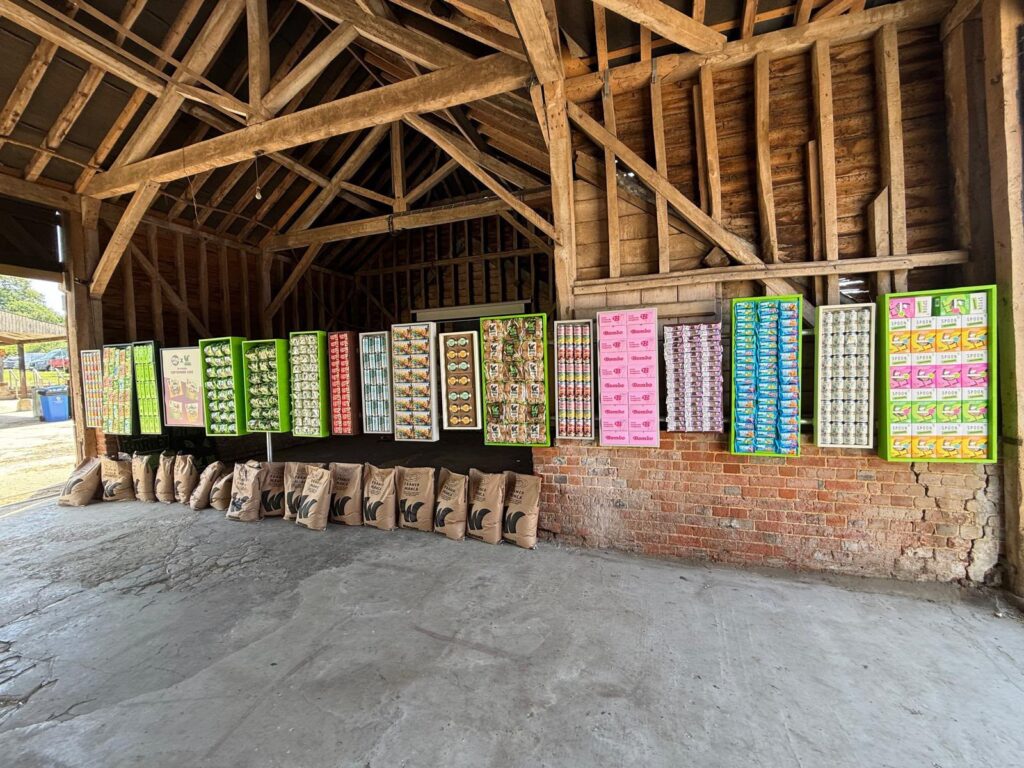
Across the two days, there were good discussions: whether quality and nature can co-exist with scale, on regen confectionery, or why Wildfarmed growers farm differently now to how they did when we started.
Here are some of the Q&As from Groundswell…
You are now working with Nestlé. Would you let any food business use Wildfarmed grains?
Yes. The first thing written on the office wall at Wildfarmed was “The Long Road to Greggs.”
Our founding mission was landscape change at scale, and the business began with a farming team to deliver financial, community and technical support to farmers.
We invested heavily in measuring outcomes to unlock the wider value of farming this way and built a traceable supply chain so that any food business, large or small, could choose grains whose field-to-plate story was known.
Over 1,000 food businesses have made that choice so far, and everyone who is using our wheat, oats or barley is directly supporting these farmers in bringing life, resilience and nature back into their fields. That’s the case whether the grain ends up in a sourdough loaf, a scone, a pint or a biscuit.
That’s why I think the question of what ingredients become must be separate to the question of how things are grown.
Some have said that regen ingredients should only be used in “healthy” foods. Let’s put aside the intractable minefield of what healthy means and who defines it and assume there could be a theoretical answer to this question.
Why restrict demand for products from regenerating farms? Why limit the supply of quality ingredients or the number of farmers able to build viable, biologically based, resilient businesses? Given how little ecological road we have, why hold farmers back?
Turning the countryside into a tapestry of viable, nature-rich farms producing resilient, low-carbon, high-quality food is overwhelmingly complex. We’re focusing on doing our best to solve these problems. Wherever the public health debate leads, we need a resilient supply of good ingredients.
I think there is something else at play here too – the old sustainability story of restriction, of hair shirts, of fewer choices. Yet the reality of farming with nature, of harnessing biology, is abundance. A forest doesn’t shrink to save itself – resilience comes from growth and expansion. Regeneration is expansive and inclusive and needs to feel that way.
Above all, we need action. 90 per cent of UK grains are grown under a conventional system, most farmers aren’t making money, and yields are being hit because soils are fragile and weather is increasingly wild. To change this, regen needs to work economically for farmers and it needs public awareness. We know from frontline experience that lack of awareness is a massive barrier to regen adoption. If everyone could come on a farm open day, the battle would be won. But they can’t, so we urgently need everyday opportunities – pints, biscuits, whatever that might be – to introduce people to the idea of knowing how their food was grown and why that matters.
We also need engagement and confidence within companies with big procurement budgets for whom quality of ingredients has historically meant consistency of supply and reliability of performance. Because of quality being defined this way, regen farming is sometimes seen as a threat to quality – a prejudice that runs deep enough for many good organic wines not to put the organic logo on the bottle. If we take KitKat as an example, this is a big step in breaking down these preconceptions because of its iconic reputation and demanding specification. Nestlé deserve credit for making this move. They did a similar thing with First Milk 20 years ago. It’s a partnership through which we hope to raise awareness of both problem and solution.
Why have you relaxed your farming standards?
We haven’t; we’ve got better at measuring and delivering outcomes.
When the first Wildfarmed standards were drawn up – the first set of third-party audited regen standards in the UK – outcomes measurements in regenerative agriculture, at scale rather than for specific experiments, didn’t exist.
That’s why we began with practice-based rules, rooted in our organic origins and based on the best evidence we could find of what was needed to deliver for nature, water and soils. Since then, we’ve dedicated so much work to measuring actual outcomes, working with a long list of specialists to track in-field biodiversity, water quality, carbon impact and farmer welfare.
That data has shown us that greater flexibility for farmers can deliver equal or better outcomes than a more prescriptive set of rules. Personally speaking, some of the evidence along the way has meant accepting long-held beliefs were wrong. It has meant standing up for a nuanced position rather than a binary one – not a comfortable place to be in a world that loves slogans.
But I think following the science and avoiding dogma is essential, given the need for farmers to build resilient ecosystems while navigating a rapidly changing climate and extremely challenging economic conditions.
Isn’t regenerative food too expensive?
It depends on what you compare it to.
UK food has looked cheap for decades – but that price has always excluded the costs being picked up elsewhere: water treatment, flood management, biodiversity loss. I think the actual question isn’t whether regenerative food costs more; it’s whether the current system really is cheaper – or whether we’ve just got used to paying for it in different ways.
On top of that, food prices have risen 40 per cent in five years, so the current system no longer guarantees cheap food.
To deal with this, I think we need economics that reflect the reality of farming. Farmers manage around 70 per cent of UK land. They are making heroic efforts in the face of economic pressure and wild weather. What they do determines the quality of our water, the resilience of our food supply, the state of our natural environment. Today, the market doesn’t reward them for any of that. The Food & Nature Resilience Fund we have launched at Groundswell is a step towards building one that does.
There are a lot of tech businesses here. Is technology the answer to regenerative farming at scale?
It depends what kind of technology.
When farm chemistry was developed, science promised to make the world repeatable and predictable; it was just a question of unearthing the rules. This approach was effective when building steam trains or microchips, but a disaster when applied to biological systems. As unforeseen consequences have unfolded over time, it has created a food system that’s expensive and fragile.
Yet while most farming technology to date has been designed to suppress biology, we’re now able to work with technology that serves it instead. Examples of that would be SAP testing and nutritional management, Trevor Tappin’s liquid applicators, or the inter-row mower I worked on for a long time, and which will hopefully one day exist in lightweight robotic form.
Rather than automating today’s fragile, chemical-dependent system and adding to farmers’ debt burden in doing so, we can instead inexpensively help farmers to read, respond and work with biology, at scale, in ways that weren’t previously possible.
Last year’s Diddly Squat data is an interesting case in point. 2025 was the driest spring in the Cotswolds for 132 years. Wildfarmed fields where technology was focused on improving biological health registered a far higher yield than the conventionally farmed fields, despite the use of variable rate and other automations that many of you will have seen on TV.
In measuring regen impact, technology is vital. From bioacoustics to AgriSound, to eDNA analysis of insect diversity or satellite crop assessments, it’s technology that’s allowed us to build the outcomes data that’s beginning to unlock value for farmers.
How much do regen yields go down compared to conventional?
We are already seeing regen fields deliver higher yields than neighbouring conventional fields during weather extremes. The last five years suggest the trajectory of extreme weather is only heading in one direction.
Even under favourable conditions, I don’t think regen yields need to go down. We can maintain yields by spending the budget used on conventional inputs on a different set of inputs – cover crop seed, different forms of nitrogen, seed inoculants, SAP-based nutrition, etc.
The challenge we have found is the required change in management to do all this optimally, given that the cost of farm machinery pushes farmers towards standardised operations across large acreages. So, I think the decrease in yield will depend on the farm’s bandwidth for more complex management. Given this bandwidth is often limited, our job continues to be finding the 20 per cent of actions that deliver 80 per cent of results.
Can regenerative farming feed the world?
This question is based on a false premise – that we can continue to feed ourselves by farming as we do today. The evidence suggests we can’t.
We find that procurement plans are often based on average yields. But the number that matters most for supply continuity is yield in bad years – and bad years are coming. We already talked about the large yield difference we saw at Diddly Squat last year, or the 40 per cent increase in food prices in five years, all of which indicate that the fragility of today’s food system in a changing climate is being exposed. Feeding ourselves into the future depends on regenerating soils and nature to make farms more resilient.
Can it be regen when your farmers don’t do Wildfarmed across all of the farm?
Working with farmers on specific blocks of land was a decision we took from the outset. Successful regen is a mindset shift – it requires depth of implementation. This is why we have such a large farming team for a small food business and why we decided to support farmers to go deeper on a section of their land rather than incrementally reduce inputs across all of it.
By running two systems side by side, farmers can see the results for themselves. What we consistently see are changes rippling out from the Wildfarmed block across the farm. With Wildfarmed barley and oats contracts now on offer, this means that when farmers are ready, we can work with them across whole rotations.
Is regen food more nutritious?
It shouldn’t take too much imagination to believe that healthier plants make healthier food. A plant growing in biologically active soil, with a functioning immune system and access to the full range of micronutrients it needs, is going to produce something nutritionally different from one growing in inert soil, kept alive by chemistry.
We now have early data that points in the same direction. For several years we’ve been testing small batches of grain, comparing Wildfarmed and neighbouring conventional fields, and have seen very significant increases in polyphenols. Last year, this was expanded into a comprehensive nutritional assessment of Wildfarmed flours against conventionally grown products. Analysis was carried out by Edacious, and again the data pointed in the same direction.
We’ll do a similar analysis after this harvest and keep building the evidence. Nutritional quality is one of the most powerful motivators for consumers choosing better food, and we want to be able to speak accurately and confidently about it.