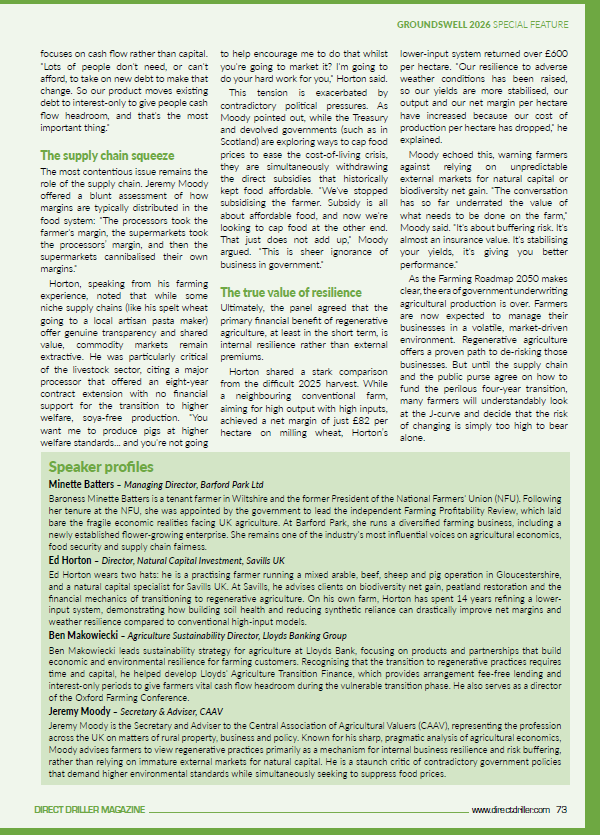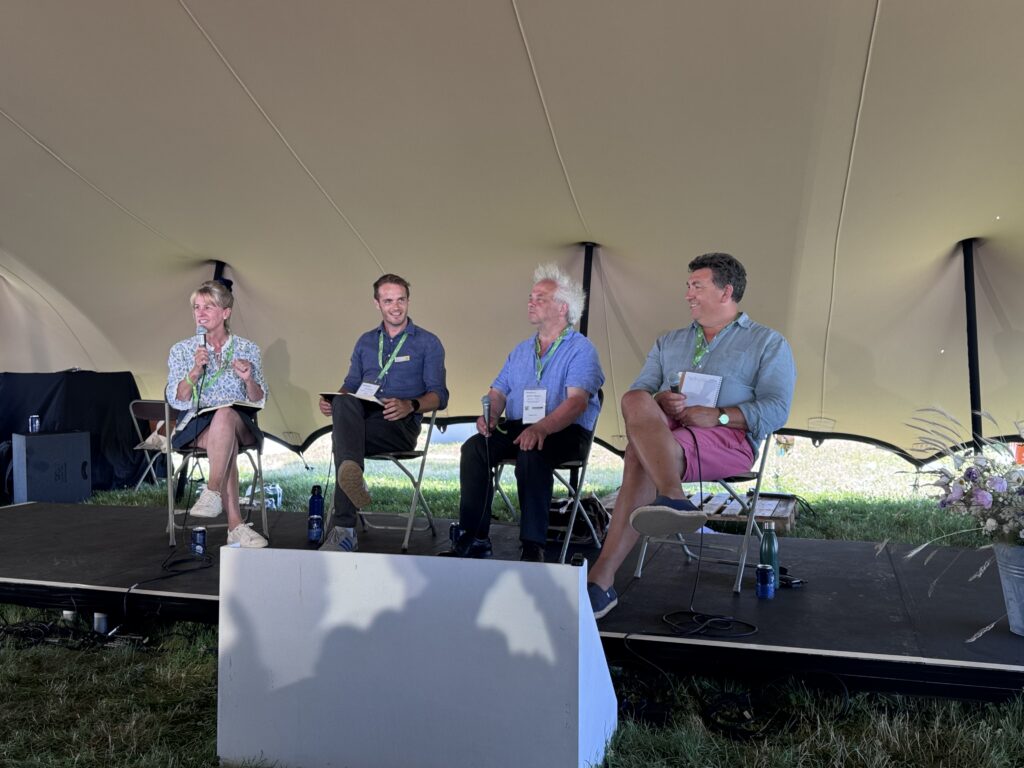
The stark reality of UK farming economics was laid bare in the Soil Tent at Groundswell 2026. The session, How Much Does it Cost to Become Regenerative and How Will I Fund That?, opened with a sobering statistic from chair Minette Batters, drawing on her recent Farming Profitability Review: over 50 per cent of all farming businesses currently fall below the level of median household earnings. Even among the top 25 per cent of farms, only 8 per cent remain profitable for 5 consecutive years.
Against this backdrop, the government’s recently published Farming Roadmap 2050 offers a vision of sustainable, resilient agriculture. Yet, as the panel discussed, the roadmap is conspicuously light on detail regarding who actually foots the bill for this monumental transition.
The panel featured Ben Makowiecki (Agriculture Sustainability Director, Lloyds Banking Group), Jeremy Moody (Secretary & Adviser, CAAV) and Ed Horton (Director of Natural Capital Investment at Savills, and a practising farmer). However, the composition of the panel highlighted a subtle, perhaps unintentional irony: the only practising farmer on the stage discussing the financial viability of regenerative agriculture also derives a significant income from a major corporate consultancy. It begs the question: is the most reliable way to fund a regenerative transition simply to get a second job off the farm?
The transition lag: Surviving the J-curve
The central challenge of moving to a regenerative system is the “J-curve” of profitability. As Ed Horton explained, drawing on joint research by Savills and Lloyds Bank, farms typically experience a four-to-five-year payback curve when changing their system.
“There is a time lag where you have to learn and educate, the system has to change, and we then see that improvement, or a return to where you were income-wise and then improvement from year five,” Horton noted. During this lag, as soil biology rebuilds and synthetic inputs are reduced, yields often dip before the system stabilises.
Minette Batters likened this to the organic sector, which has long recognised the financial vulnerability of the transition period and provides specific conversion payments to bridge the gap. “That conversion payment is purely there because there is that lag in production where you actually almost go backwards before you go forwards,” she said.
However, in the broader regenerative space, public funding specifically designed to cover this conversion lag remains limited. The Farming Roadmap 2050 leans heavily on the expectation that private finance will step in. But as Ben Makowiecki pointed out, the roadmap provides “very little detail about what that means and how it’s meant to be done. It’s kind of there as, ‘It’s all right, private finance will cover the rest.'”
Who should pay? The public purse vs the private beneficiary
If farmers cannot shoulder the cost of the transition lag alone, where does the money come from? Makowiecki offered a clear division of responsibility between the public and private sectors.
“Practice change should partially be covered by the public purse because it is a public good,” he argued. “Transforming the system is a public good. Otherwise, we don’t have food security, we don’t have resilient farms, and we don’t have food.”
Once the transition is underway, Makowiecki suggested that private funding should pay for the specific outcomes generated. He cited Lloyds Bank’s recent partnership with Wildfarmed as an example. Wildfarmed aims to scale its regenerative grain supply from 8,500 hectares to 300,000 hectares over ten years. To achieve this without diluting the premium paid to growers, Lloyds is bringing in external money from entities that benefit from the resulting ecosystem services – such as flood risk mitigation and biodiversity improvements – to fund the expansion.
For farmers unwilling or unable to take on new debt to fund the transition, Makowiecki noted that Lloyds’ Agriculture Transition Finance product focuses on cash flow rather than capital. “Lots of people don’t need, or can’t afford, to take on new debt to make that change. So our product moves existing debt to interest-only to give people cash flow headroom, and that’s the most important thing.”
The supply chain squeeze
The most contentious issue remains the role of the supply chain. Jeremy Moody offered a blunt assessment of how margins are typically distributed in the food system: “The processors took the farmer’s margin, the supermarkets took the processors’ margin, and then the supermarkets cannibalised their own margins.”
Horton, speaking from his farming experience, noted that while some niche supply chains (like his spelt wheat going to a local artisan pasta maker) offer genuine transparency and shared value, commodity markets remain extractive. He was particularly critical of the livestock sector, citing a major processor that offered an eight-year contract extension with no financial support for the transition to higher welfare, soya-free production. “You want me to produce pigs at higher welfare standards… and you’re not going to help encourage me to do that whilst you’re going to market it? I’m going to do your hard work for you,” Horton said.
This tension is exacerbated by contradictory political pressures. As Moody pointed out, while the Treasury and devolved governments (such as in Scotland) are exploring ways to cap food prices to ease the cost-of-living crisis, they are simultaneously withdrawing the direct subsidies that historically kept food affordable. “We’ve stopped subsidising the farmer. Subsidy is all about affordable food, and now we’re looking to cap food at the other end. That just does not add up,” Moody argued. “This is sheer ignorance of business in government.”
The true value of resilience
Ultimately, the panel agreed that the primary financial benefit of regenerative agriculture, at least in the short term, is internal resilience rather than external premiums.
Horton shared a stark comparison from the difficult 2025 harvest. While a neighbouring conventional farm, aiming for high output with high inputs, achieved a net margin of just £82 per hectare on milling wheat, Horton’s lower-input system returned over £600 per hectare. “Our resilience to adverse weather conditions has been raised, so our yields are more stabilised, our output and our net margin per hectare have increased because our cost of production per hectare has dropped,” he explained.
Moody echoed this, warning farmers against relying on unpredictable external markets for natural capital or biodiversity net gain. “The conversation has so far underrated the value of what needs to be done on the farm,” Moody said. “It’s about buffering risk. It’s almost an insurance value. It’s stabilising your yields, it’s giving you better performance.”
As the Farming Roadmap 2050 makes clear, the era of government underwriting agricultural production is over. Farmers are now expected to manage their businesses in a volatile, market-driven environment. Regenerative agriculture offers a proven path to de-risking those businesses. But until the supply chain and the public purse agree on how to fund the perilous four-year transition, many farmers will understandably look at the J-curve and decide that the risk of changing is simply too high to bear alone.
Speaker profiles
Minette Batters – Managing Director, Barford Park Ltd
Baroness Minette Batters is a tenant farmer in Wiltshire and the former President of the National Farmers’ Union (NFU). Following her tenure at the NFU, she was appointed by the government to lead the independent Farming Profitability Review, which laid bare the fragile economic realities facing UK agriculture. At Barford Park, she runs a diversified farming business, including a newly established flower-growing enterprise. She remains one of the industry’s most influential voices on agricultural economics, food security and supply chain fairness.
Ed Horton – Director, Natural Capital Investment, Savills UK
Ed Horton wears two hats: he is a practising farmer running a mixed arable, beef, sheep and pig operation in Gloucestershire, and a natural capital specialist for Savills UK. At Savills, he advises clients on biodiversity net gain, peatland restoration and the financial mechanics of transitioning to regenerative agriculture. On his own farm, Horton has spent 14 years refining a lower-input system, demonstrating how building soil health and reducing synthetic reliance can drastically improve net margins and weather resilience compared to conventional high-input models.
Ben Makowiecki – Agriculture Sustainability Director, Lloyds Banking Group
Ben Makowiecki leads sustainability strategy for agriculture at Lloyds Bank, focusing on products and partnerships that build economic and environmental resilience for farming customers. Recognising that the transition to regenerative practices requires time and capital, he helped develop Lloyds’ Agriculture Transition Finance, which provides arrangement fee-free lending and interest-only periods to give farmers vital cash flow headroom during the vulnerable transition phase. He also serves as a director of the Oxford Farming Conference.
Jeremy Moody – Secretary & Adviser, CAAV
Jeremy Moody is the Secretary and Adviser to the Central Association of Agricultural Valuers (CAAV), representing the profession across the UK on matters of rural property, business and policy. Known for his sharp, pragmatic analysis of agricultural economics, Moody advises farmers to view regenerative practices primarily as a mechanism for internal business resilience and risk buffering, rather than relying on immature external markets for natural capital. He is a staunch critic of contradictory government policies that demand higher environmental standards while simultaneously seeking to suppress food prices.